
Sulfide ore bodies do not sit quietly at the surface. When groundwater carrying dissolved oxygen reaches them, sulfides oxidise, metals go into solution, and the top of the deposit is rebuilt into something entirely different. The rusty, cellular, iron-stained rock left at the surface is called a gossan, and for centuries it was how prospectors found ore at all.
What happens chemically
Pyrite, the most abundant sulfide, oxidises to produce iron oxides and sulfuric acid. That acid attacks the surrounding sulfides and dissolves the metals they contain: copper, zinc, lead, silver.
Iron is the exception. Ferric iron is essentially insoluble, so while copper and zinc are carried downward in solution, iron stays put as a residual mass of goethite, hematite and limonite. That residue, riddled with boxwork cavities where sulfide crystals used to be, is the gossan. It is the skeleton of an ore body with the valuable parts leached out.
The iron minerals involved are the subject of hematite and goethite, and the residual textures are a large-scale relative of the replacement process in pseudomorphs.
The three-layer structure
A mature oxidised sulfide deposit reads top to bottom like this.
The gossan, at the surface. Iron oxides, quartz, boxwork texture, almost no recoverable metal.
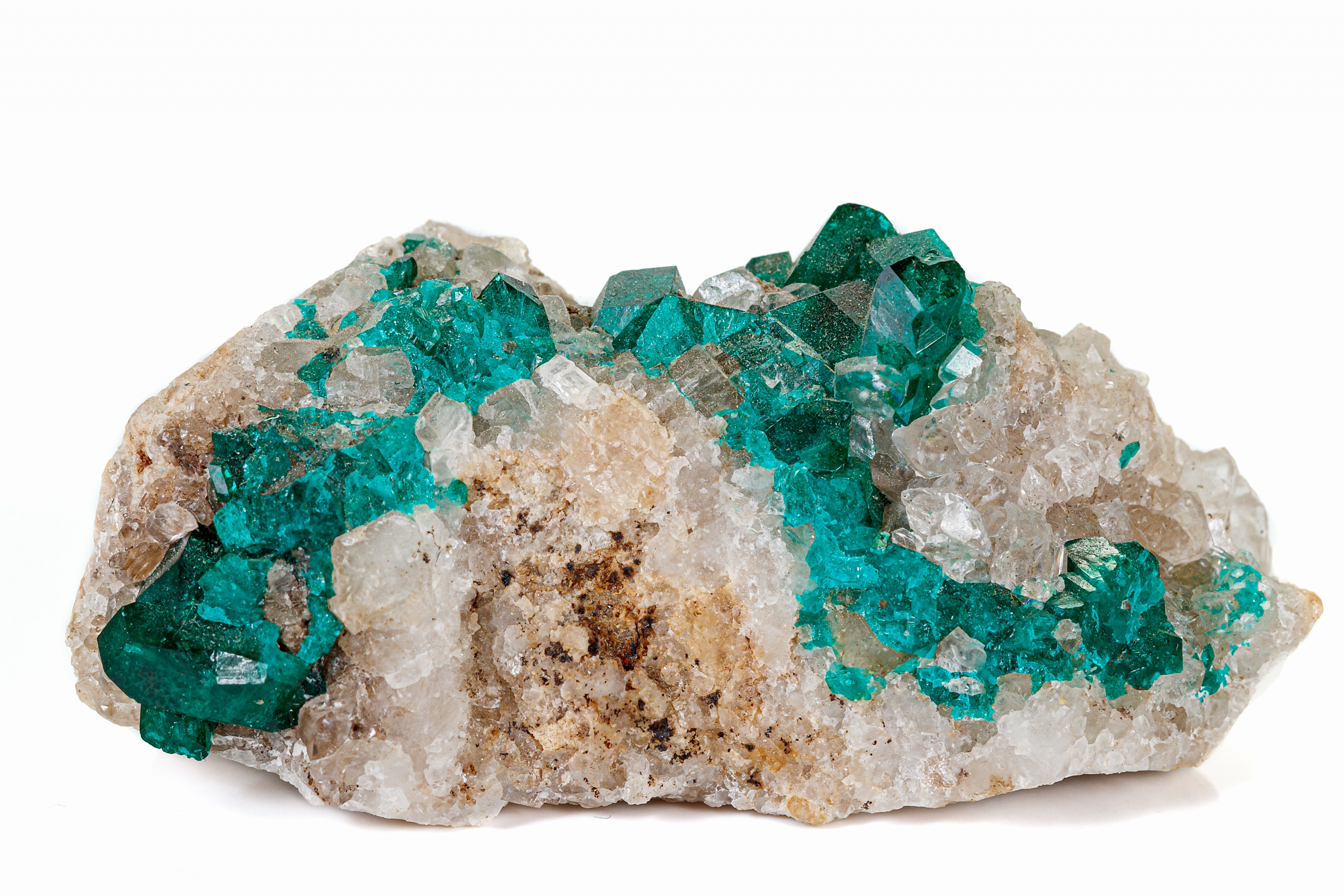
The oxidation zone, below it and above the water table. Here dissolved metals re-precipitate as oxides, carbonates, silicates and sulfates. This is where the beautiful copper minerals live: malachite, azurite, chrysocolla, cuprite, brochantite.
The zone of supergene enrichment, at and just below the water table. Descending copper-bearing solutions meet reducing conditions and precipitate secondary copper sulfides such as chalcocite. Because they are dumping copper leached from everything above, these zones can be dramatically richer than the original ore. Many historic copper mines were economic only because of supergene enrichment, and became marginal the moment they mined through it into unenriched primary sulfide.
Why collectors care
Nearly every striking copper mineral in circulation comes from an oxidation zone. Primary copper ore is chalcopyrite, which is brassy and honestly not very interesting. The colours appear only after oxidation.
Our azurite crystal and chrysocolla and shattuckite are both oxidation-zone minerals, and their formation is discussed in azurite and chrysocolla and shattuckite. Malachite is the same story, and turquoise forms in oxidised copper settings too.
Azurite converting to malachite over time is a direct consequence of this environment. Azurite is stable in more carbon-dioxide-rich conditions; as conditions shift, it alters to malachite while frequently keeping its original crystal shape, which is one of the most commonly encountered pseudomorphs in any collection.
How prospectors used it
A gossan is visible from a distance: a rusty red-brown outcrop standing out against normal country rock. Trained prospectors read texture and colour for hints about what had been leached. Boxwork shape reflects the crystal form of the vanished sulfide, so a cubic boxwork suggests pyrite while other shapes suggest other species.
Traces of remaining copper minerals, malachite staining in particular, said copper below. This is the ore-deposit equivalent of the upstream tracing described in placer deposits: read the dispersed evidence, then find the source.
The underlying vein systems, before oxidation got to them, formed by the process in hydrothermal veins. A gossan is what the surface does to that afterwards.