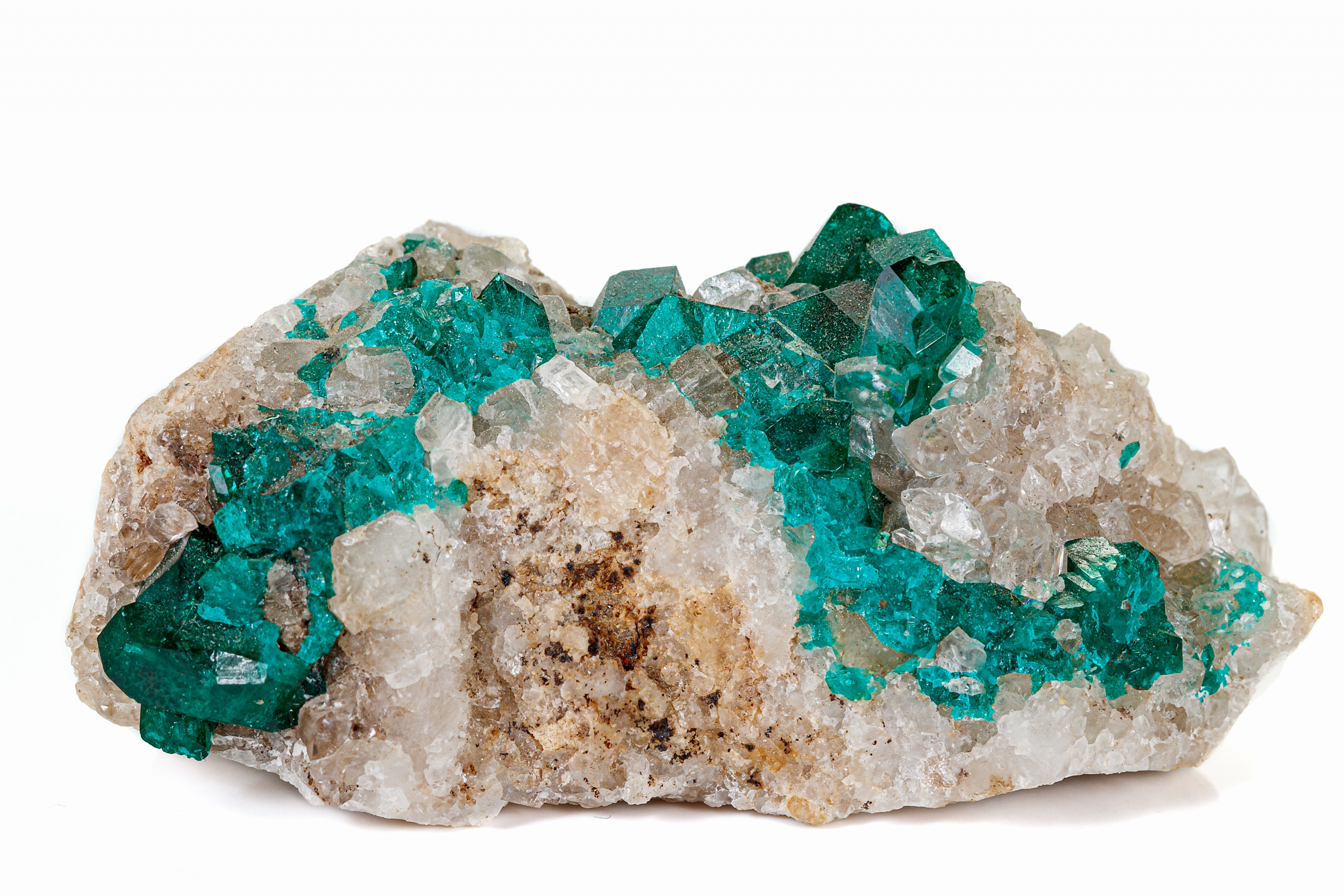

Experienced field collectors do something that looks vandalistic to beginners. They pick up a promising rock and immediately hit it with a hammer. The reason is simple: the outside of a rock is frequently not the rock.
Desert varnish
In arid regions, exposed rock surfaces develop a thin dark coating, usually under a tenth of a millimetre thick, ranging from orange-brown to nearly black. It has a faint sheen and it can make basalt, sandstone and quartzite look practically identical.
The composition is the surprise. Desert varnish is mostly clay minerals, roughly 60 to 70 percent, cemented with manganese and iron oxides. The clay is windborne dust, not weathered from the rock beneath. The manganese content can be hundreds of times higher than the underlying rock, so the manganese also arrives from outside.
The concentration mechanism is still debated, with strong evidence that manganese-oxidising microorganisms living on the surface are involved. Growth is extremely slow, on the order of micrometres per thousand years, which is why archaeologists use varnish to study petroglyphs: carving through the varnish exposes fresh rock, and the rate at which varnish re-forms over the carving gives a rough relative age.
Weathering rinds
Different process, similar consequence. A rind is a zone where the rock itself has been chemically altered inward from the surface: feldspars converting to clay, iron minerals oxidising, the rock softening and changing colour.
This is the reaction described in feldspar, where silicates break down to clay in the presence of water and dissolved carbon dioxide. Rinds on basalt cobbles thicken with time in a roughly predictable way, and geomorphologists use rind thickness to compare the relative ages of river terraces and glacial deposits.
The practical point is that a rind can be centimetres thick. A fist-sized cobble can be altered most of the way through while its interior is completely fresh.
Patina, cortex and the toolmaking connection
Flint nodules carry a white or cream cortex, a chemically altered outer zone. Knappers work through it to reach the unaltered flint inside, and the presence or absence of cortex on a stone tool tells archaeologists where in the reduction sequence that flake came from. Chalcedony and flint are covered in agate and chalcedony.
Old surfaces on flint also develop their own patina over millennia, which is one line of evidence for distinguishing a genuinely ancient tool from a recent replica.
Why this matters when identifying
Nearly every property you would use to identify a mineral in the field is a surface property, and every one of them can be a lie:
- Colour may belong to the coating.
- Lustre is a surface property by definition.
- Hardness tested on a weathered surface reads soft, because the surface is altered.
- Habit may be rounded off by abrasion, obscuring the form discussed in crystal habit.
This is why the streak test is so reliable. Powdering the mineral destroys the surface and tests the material. It is also why a fresh broken face beats a weathered one for every determination described in reading a specimen without a label.
When not to remove it
There is a real tension here for specimens rather than field identification. A natural patina is part of a piece’s history, and aggressive cleaning can destroy both character and value. Removing varnish from a petroglyph panel would be an act of destruction.
For a collection piece, remove loose dirt and leave chemistry alone unless you know exactly what you are doing, which is the position taken in cleaning and storing specimens. Old vintage material in particular carries a surface history that cannot be put back. Our large pink vintage crystal is a piece whose exact identity is honestly unknown rather than guessed, and stripping it would remove evidence rather than reveal it.