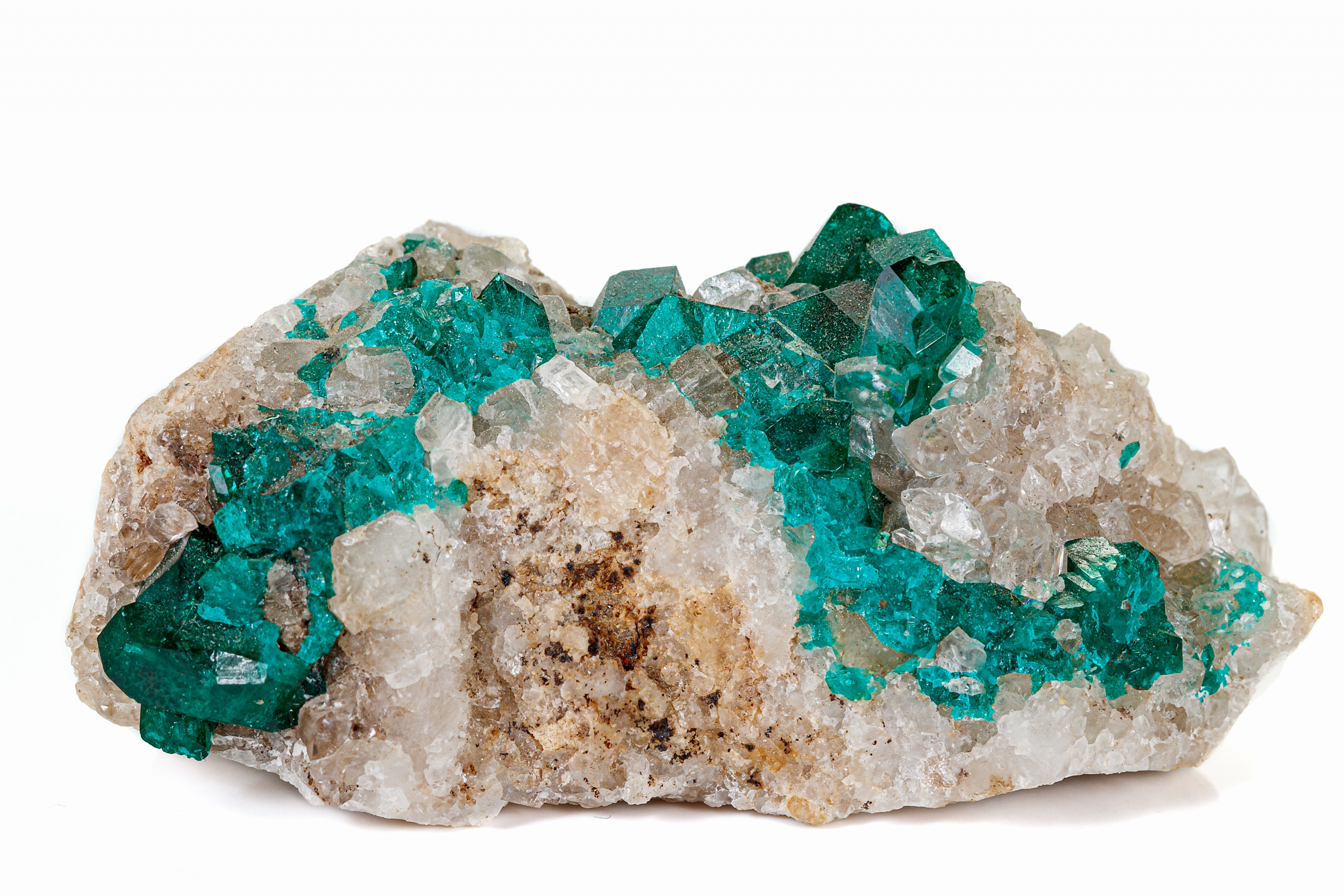

Hematite and goethite are two of the most common iron minerals on Earth, and on their own neither one is particularly flashy. Hematite is a dependable red-brown ore mineral, and goethite is the rust-colored byproduct of nearly every weathered iron deposit around. But at a hillside in Lincoln County, Georgia, called Graves Mountain, the two of them team up on the surface of the same specimens to throw off a genuine, full-spectrum rainbow.
Hematite: unglamorous chemistry, a very long résumé
Hematite is iron oxide, Fe2O3, roughly 70 percent iron by weight, and it’s the single most important ore of iron on the planet. Its surface color is all over the map, from metallic silver-gray to earthy red-brown to black, which makes color useless for identifying it. The one test that never fails is the streak: scratch hematite across an unglazed tile and it leaves a red-brown mark every time. The name comes from the Greek haima, for blood, and people have been grinding hematite into red pigment for at least 40,000 years, showing up in cave paintings long before anyone thought of it as an ore. Most of the world’s hematite deposits are far older than that history. They formed roughly 2.4 billion years ago, when early photosynthetic bacteria started releasing oxygen into oceans still saturated with dissolved iron, laying down the massive banded iron formations that still supply most of the world’s steel industry.
Goethite: named for a poet who dabbled in minerals
Goethite is iron oxide-hydroxide, FeO(OH), and it’s the second most abundant iron oxide mineral after hematite. It typically forms as a weathering product, when minerals like pyrite and magnetite oxidize near the surface. It’s also, chemically speaking, the main ingredient in ordinary rust. The name honors Johann Wolfgang von Goethe, the German writer better remembered for Faust than for mineralogy, though he took mineral collecting seriously enough to earn the credit in 1806. Oddly, the name was first applied to what turned out to be a different mineral entirely, now called lepidocrocite, which shares goethite’s chemistry but not its crystal structure.
Where the color comes from
Graves Mountain has produced plenty of well-known minerals over the years, including rutile, lazulite, and pyrophyllite, but collectors know it best for iridescent hematite, sometimes still labeled with the old name turgite. Research into iridescent iron oxides has traced the color to an ultra-thin coating, roughly 200 to 500 nanometers thick, made of rod-shaped aluminum-phosphate or aluminum-arsenate nanocrystals sitting directly on top of the hematite and goethite. Light bouncing through a film that thin interferes with itself the same way it does in a soap bubble or a film of oil on a wet driveway, splitting into a full spectrum of color that shifts as the viewing angle changes. Where that coating has worn away, the plain metallic hematite underneath shows through.
Nothing about the piece in the case is painted or artificially treated. It’s ordinary iron ore wearing a coat only a few hundred nanometers thick, thin enough to bend light into every color at once.