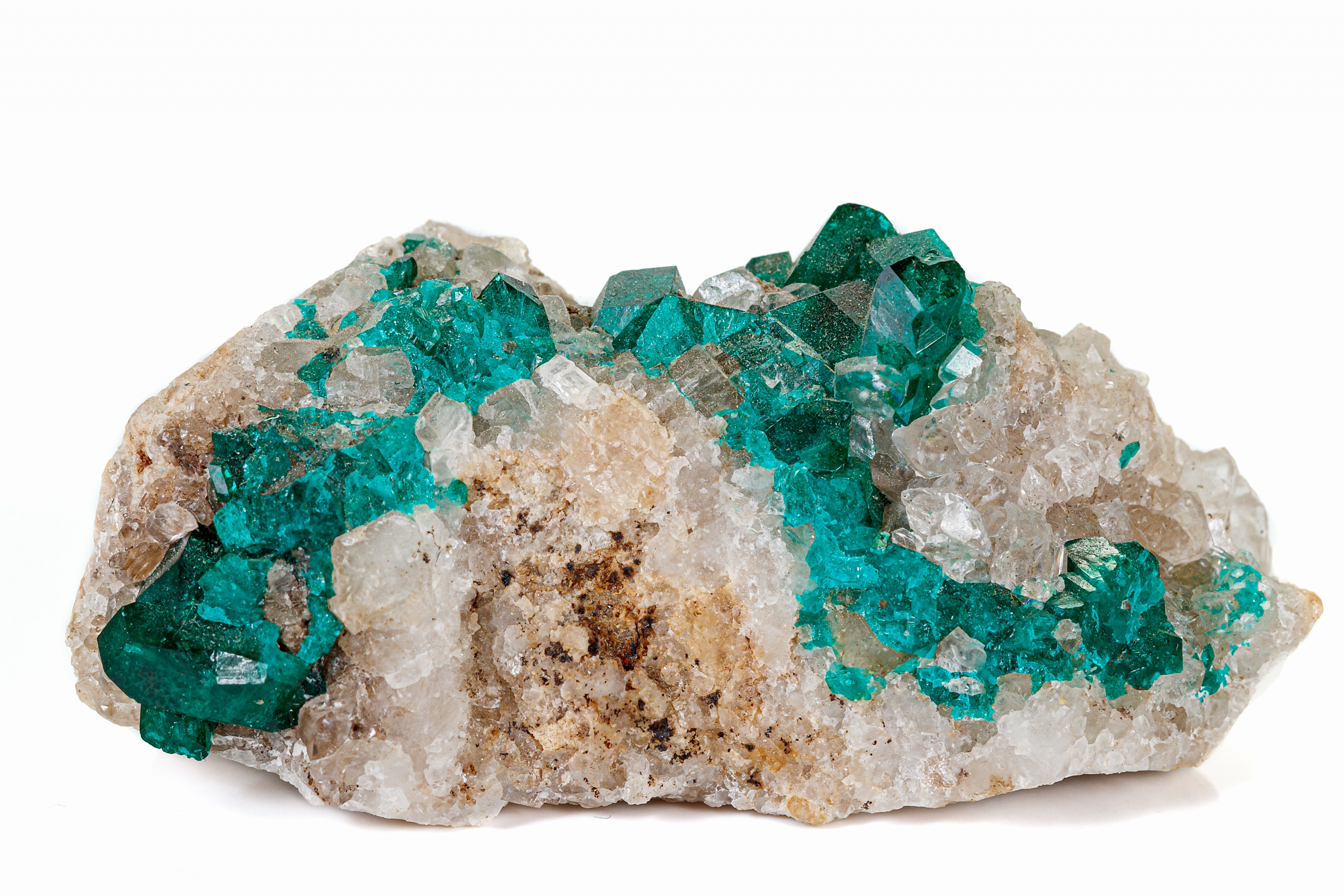
Turquoise gets the fame, but a lot of what people assume is turquoise in a mixed lot of stones is actually one of two much less famous copper minerals: chrysocolla or shattuckite. Both form in the same kind of place, both borrow their color from copper, and both regularly get misidentified by people who aren’t looking closely.
Chrysocolla: a byproduct of weathering copper
Chrysocolla is a hydrous copper silicate that forms where copper deposits sit exposed to weathering and groundwater near the surface. As primary copper minerals like chalcopyrite break down, the copper dissolves, migrates, and recombines with silica to crystallize as chrysocolla, usually in banded or botryoidal masses alongside malachite, azurite, and cuprite. Its color runs from sky blue to blue-green depending on exactly how much copper made it into the final structure.
Too soft to wear, too pretty to skip
On its own, chrysocolla is a poor choice for jewelry. It sits at only 2.5 to 3.5 on the Mohs scale, soft enough that ordinary daily wear will scratch it. Cutters get around that by pairing chrysocolla with quartz, either as natural inclusions inside chalcedony, marketed as “gem silica” and among the most valuable copper minerals in the world, or by stabilizing softer material with resin. Without help from quartz, chrysocolla stays a display and cabinet specimen rather than something set in a ring.
Shattuckite: a mineral named after the mine that made it famous
Shattuckite tells a more specific story. It was first identified in 1915 at the Shattuck Mine in Bisbee, Arizona, one of the richest copper districts in American history, and takes its name directly from that mine. Chemically it’s a copper silicate hydroxide, and at its type locality it commonly forms as a pseudomorph after malachite, replacing malachite’s crystals atom by atom while keeping malachite’s original shape. The result looks like malachite that decided to be blue instead of green.
Why the mix-up happens
Turquoise, chrysocolla, and shattuckite all land in a similar blue-to-blue-green range, and none of them are common enough for most people to have handled all three side by side. Turquoise is a phosphate, though, not a silicate, and it’s harder and more durable than either copper mineral, which is the fastest real-world way to tell them apart once you know to check.
Bisbee alone was productive enough to give the mineral world both a namesake mine and a small identification headache that’s still going on today.