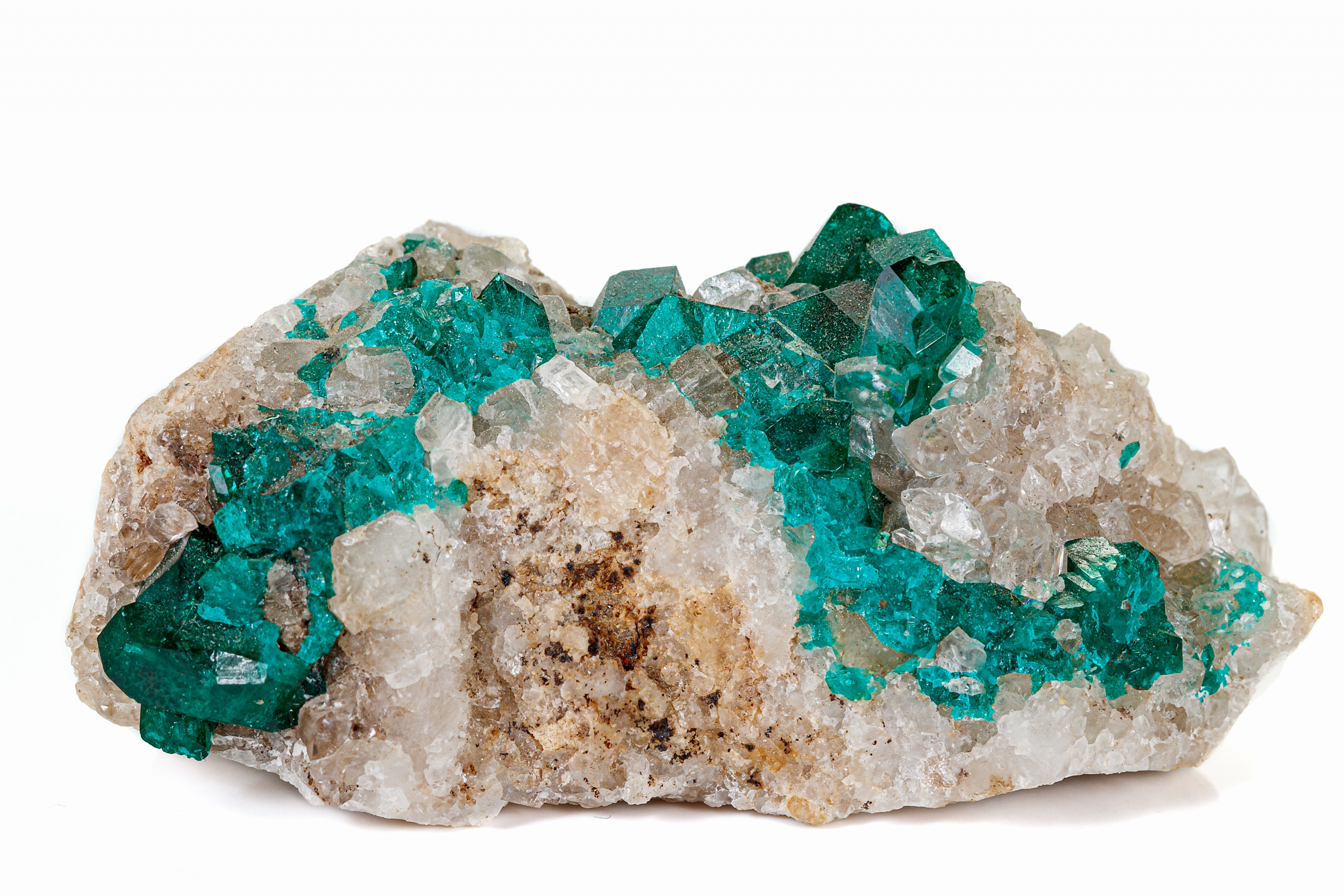

Turquoise has a reputation for looking basically the same everywhere it’s sold, robin’s-egg blue, often veined with dark matrix. In the ground, it’s a genuinely variable mineral, and two pieces from the same mine can differ enough in color and hardness that they’d be hard to match by eye.
A secondary mineral, not a primary one
Turquoise, a hydrated copper aluminum phosphate, doesn’t crystallize directly from molten rock or a single clean hydrothermal event the way quartz or beryl does. It forms as a secondary mineral, precipitating slowly out of groundwater as that water percolates through copper-bearing rock in arid environments, filling fractures and cavities over long stretches of time. That slow, opportunistic formation is why turquoise so often shows up intergrown with its host rock as matrix rather than as clean, separable crystals, and why copper minerals like chrysocolla and shattuckite get mistaken for turquoise so often, they form through broadly similar copper-and-water chemistry in similar arid settings.
Why color and hardness vary so much by mine
Turquoise’s blue comes from copper; where iron substitutes in instead, the stone shifts toward green. Softer, more porous turquoise, common in material from shallower deposits, is also more prone to absorbing oils and changing color over years of handling, which is part of why treated and stabilized turquoise, resin-impregnated to improve durability, dominates the modern market far more than the untreated stone most buyers picture.
The variability is, in a sense, the whole identity of the mineral. Turquoise from different mines has historically been valued and traded almost like a place name as much as a gemstone, a different situation from most minerals, where locality is a footnote rather than the main selling point.