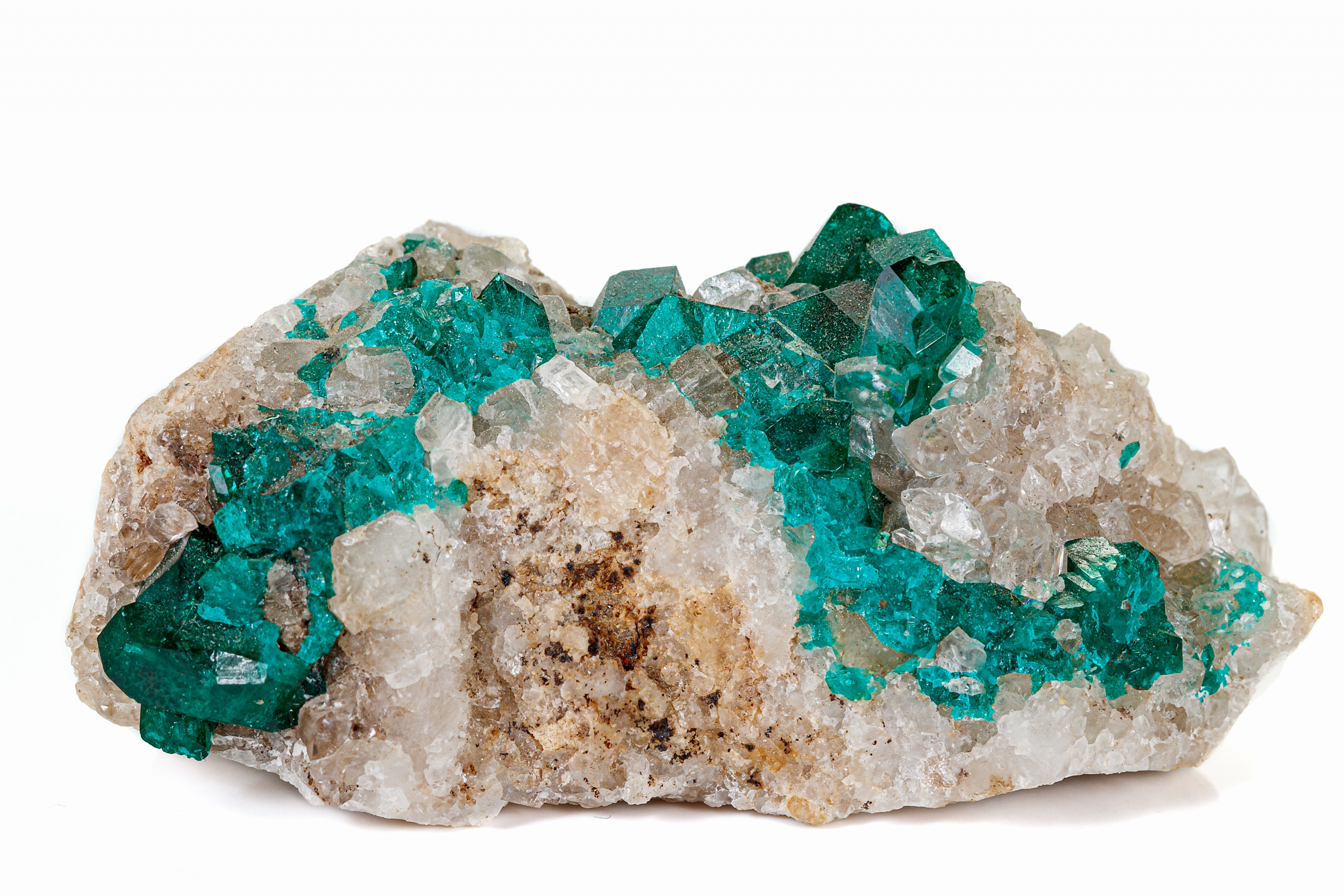

The Moon is made of the same material as Earth, formed at the same time, from the same collision. It has somewhere around 350 mineral species. Earth has roughly 6,000. That gap is not an accident of sampling. It is the single most interesting fact in mineralogy.
Minerals have a history
The idea, developed by Robert Hazen and colleagues from 2008 onward, is that the diversity of minerals is not fixed but has increased over time in identifiable stages. Ask when a mineral first became possible and you get a timeline rather than a list.
The presolar stage. Around a dozen minerals in the dust of dying stars: diamond, graphite, moissanite, corundum, a few oxides and silicates. This is the entire mineral inventory of the universe before planets.
Planetary accretion. Melting, differentiation and a first generation of igneous processing pushes the count to roughly 250 species. This is the Moon, and broadly Mercury.
Plate tectonics and water. Subduction, hydrothermal circulation, weathering, sedimentary processing. Recycling crust repeatedly concentrates rare elements into settings where they can form their own minerals rather than remaining scattered traces. This is where pegmatites, hydrothermal veins and the whole rock cycle come in. Count reaches roughly 1,500.
Oxygen. And here the number explodes.
Two thirds of all minerals require life
By most estimates, well over half and plausibly around two thirds of known mineral species could not exist without biology, almost all of them because they require free oxygen.
Before the Great Oxidation Event there was no atmospheric oxygen, so oxidised minerals could not form. Once cyanobacteria changed the atmosphere, every element with more than one oxidation state suddenly had new chemistry available. Copper, iron, manganese, uranium and dozens of others could form oxides, carbonates, sulfates and hydroxides that were previously impossible.
This is why the entire oxidation zone of an ore deposit is a biological artefact. Azurite, malachite, turquoise and our own chrysocolla and shattuckite are all downstream of photosynthesis. So are the banded iron formations that supply the world’s iron, and the iridescent hematite on our shelf.
Life builds minerals directly too
Beyond changing the atmosphere, organisms precipitate minerals themselves. Shells and coral of aragonite and calcite, covered in polymorphs. Bone and enamel of hydroxylapatite, covered in apatite. Magnetite crystals inside magnetotactic bacteria. Diatom and radiolarian skeletons of opaline silica.
Biomineralisation also produces most of the world’s limestone, which then feeds back into everything: caves, speleothems, marble, and the calcite specimens in every shop.
The rare ones are the interesting ones
A related finding from the same research: mineral species follow a steep frequency distribution. Roughly 100 species make up almost all of Earth’s crust, while more than half of all known minerals are known from five or fewer localities, and many from exactly one.
Charoite is the famous case. Such minerals need an improbable combination of ingredients and conditions, which is why they are geographically pinned. The element-abundance side of this is in the periodic table and mineral rarity.
Hazen’s group also argued that this rarity is statistical evidence for the biological claim: if you reran Earth’s history, the common minerals would recur and the rare ones largely would not.
Why it matters beyond Earth
If mineral diversity tracks biological activity, then mineralogy becomes a biosignature. A planet with thousands of species, particularly oxidised and hydrated ones, is a planet worth a much closer look. Mars, red from iron oxidation without the biology, as noted in banded iron formations, sits somewhere in the middle of that spectrum.
Every one of the roughly 100 new species approved each year under the process in how a new mineral becomes a mineral is another data point in a story that runs from stardust to now.