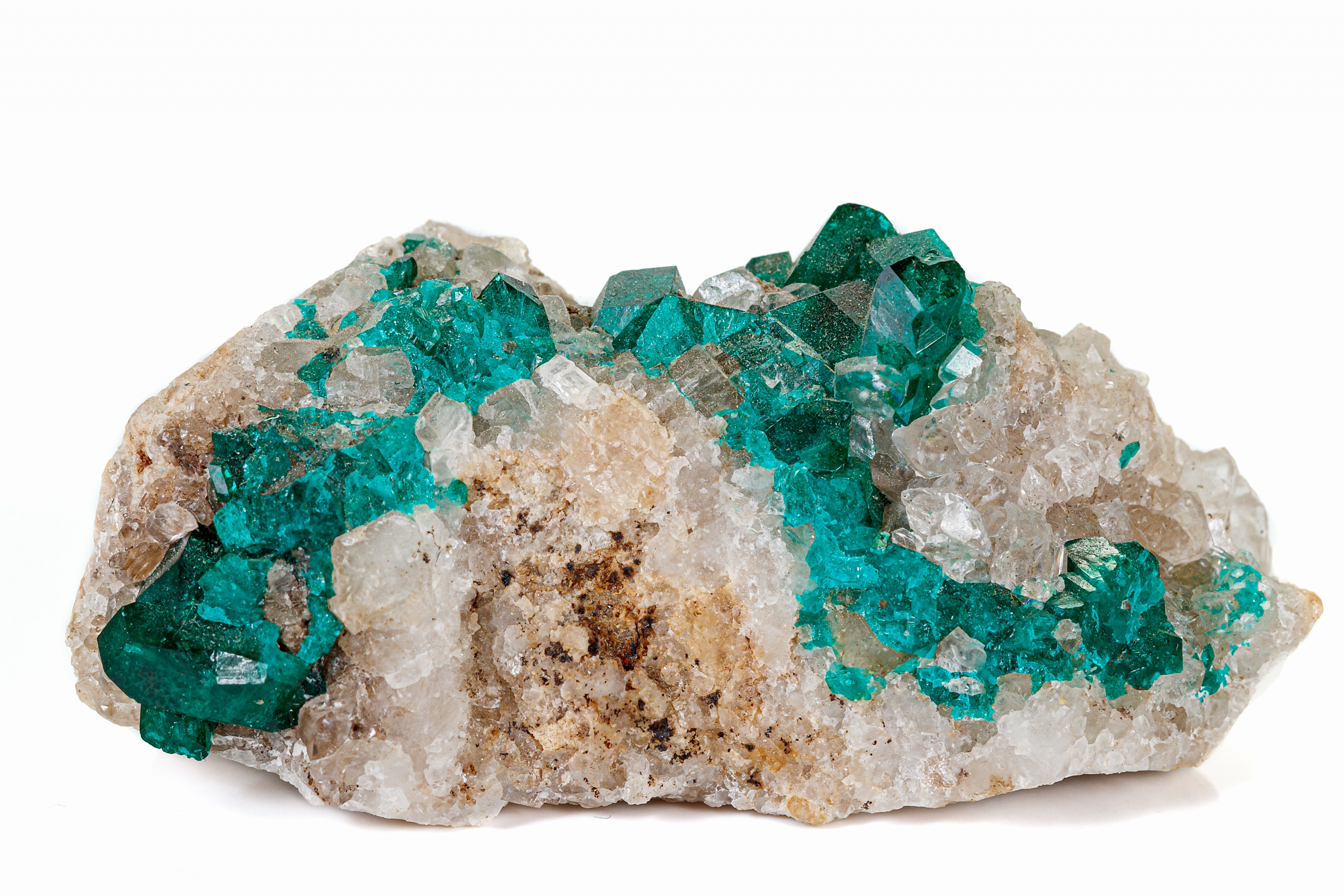

Most minerals are things you look at. Apatite is a mineral you are made of.
A mineral that grows inside you
Apatite is not one mineral but a small family of calcium phosphates, separated by whichever element sits in one particular site in the structure: fluorapatite (fluorine), chlorapatite (chlorine) and hydroxylapatite (a hydroxyl group). That last one is the important one, because hydroxylapatite is the mineral component of vertebrate bone and tooth enamel. Roughly 96 percent of enamel by weight is a carbonate-bearing hydroxylapatite. Your skeleton is a biologically assembled phosphate mineral with a protein scaffold.
This is also why fluoride works. Acid produced by bacteria dissolves hydroxylapatite fairly readily. When fluoride ions are present during remineralisation, they substitute into that site and produce fluorapatite, which is measurably less soluble in acid. Fluoride toothpaste is, in a literal sense, a mineral-substitution treatment performed on a crystal you grew yourself.
Number five on the scale
Apatite occupies position 5 on the Mohs hardness scale, the reference point between fluorite and orthoclase feldspar. Friedrich Mohs picked it in 1812 because it was common, available and reliably consistent. Tooth enamel sits at roughly the same hardness, which is a neat coincidence and a useful one, since it means apatite is hard enough to handle but soft enough that a steel knife blade will scratch it.
Hardness is not toughness, though, and apatite is a good illustration of the difference. It is brittle, it has a distinct parting, and it chips at edges more easily than its hardness number suggests. If you want that distinction spelled out, the post on hardness versus toughness covers it properly.
The blue ones
Gem and specimen apatite turns up in blue, green, yellow, violet and colourless. The strong blue-to-teal material most people recognise owes its colour to trace amounts of rare earth elements and to colour centres created by natural irradiation, which is why apatite blues vary so widely between localities. Madagascar, Brazil and Myanmar are the best-known sources for the saturated blue-green tumbling and cabochon rough.
Our current set of seven tumbled blue apatite stones is exactly this material: opaque to translucent, mid-blue, polished to a soft glassy lustre. At Mohs 5 they are on the soft side for a tumbled stone, which is worth knowing before you toss them in a pocket with quartz.
Feeding the planet
Here is the part nobody expects. Apatite is the single most important source of phosphorus on Earth, and phosphorus is one of the three elements that agriculture cannot do without. Somewhere around 90 percent of all phosphate rock mined globally goes straight into fertiliser production. The mineral in your tumbled stone is the same mineral that stands between modern agriculture and a very different food supply.
Unlike nitrogen, phosphorus cannot be pulled out of the atmosphere. Every phosphate atom in the fertiliser system was mined from a rock, most of it from sedimentary apatite deposits laid down on ancient continental shelves. There is no synthetic substitute.
A clock inside the crystal
Geologists use apatite for something else entirely: dating. Apatite contains trace uranium, and when uranium atoms fission they leave microscopic damage trails through the crystal lattice. Those tracks anneal, meaning they heal shut, above roughly 110 degrees Celsius. Count the surviving tracks and you can tell when a piece of rock last cooled through that temperature, which in practice tells you when a mountain range was uplifted and eroded. Apatite fission-track dating is one of the standard tools for reconstructing the exhumation history of mountain belts.
Looking after it
Apatite is soft, brittle and, importantly, attacked by acids. Do not clean it with anything acidic, do not put it in an ultrasonic cleaner, and store it where harder stones cannot rub against it. Warm water, a soft brush and patience is the whole routine. The general guide to cleaning and storing specimens applies here with the acid warning underlined.
It is an unusual thing to hold. Most specimens on a shelf are geology. This one is also biology, agriculture and geochronology at the same time.