
Pick up a well-formed quartz point and you’ll notice something odd if you stop to think about it: six flat faces, meeting at consistent angles, on a crystal that grew underground with no mold, no template, and nobody around to shape it. Snap that same quartz in half and grow a new one from scratch on the other side of the planet, and it comes out with the same angles. That’s not a coincidence, and it isn’t really about quartz specifically — it’s about how atoms stack.
The short version: a mineral’s crystal shape is a direct readout of its atomic structure. Every mineral has a defined chemical formula and a specific way its atoms, ions, or molecules pack together in a repeating 3D lattice. That repeating unit — called a unit cell — tiles outward in every direction as the crystal grows, and the external faces you can see and touch are just the outermost edge of that internal stacking pattern. Change the stacking, change the shape. There is no other input.
Six lattice families, six broad looks
Mineralogists group every possible lattice geometry into seven crystal systems (six if you count two closely related ones together), based on the symmetry of the unit cell — how many equal axes it has and what angles they meet at. You don’t need the full technical breakdown to see it in a specimen case, though. A few show up constantly in mineral collecting:
Quartz crystallizes in the trigonal system, which is why a piece like this double-terminated smoky quartz point shows that familiar six-sided prism capped by six-sided pyramids at each end — the “point” shape most people picture when they hear the word crystal. Calcite crystallizes in a related system with a signature rhombohedral cleavage, which is exactly what’s happening in this Ohio calcite point: it doesn’t break randomly the way glass does, it shears along flat planes dictated by the weakest bonds in its lattice, over and over, at the same angle every time.
Then there are habits that come from how a crystal grows rather than how it breaks. Herkimer diamonds are quartz too, chemically identical to the smoky point above, but they typically terminate at both ends because they grew freely inside a fluid-filled cavity in the host rock instead of being anchored to a wall at one end — this smoky Herkimer is a clean example. Stilbite goes a different direction almost entirely: its crystals form as thin, radiating blades that fan out from a central point, and when two of those fans grow across each other you get the “bowtie” shape stilbite is named for — visible edge-on in this New Jersey lot.
Same lattice rule, wildly different-looking minerals
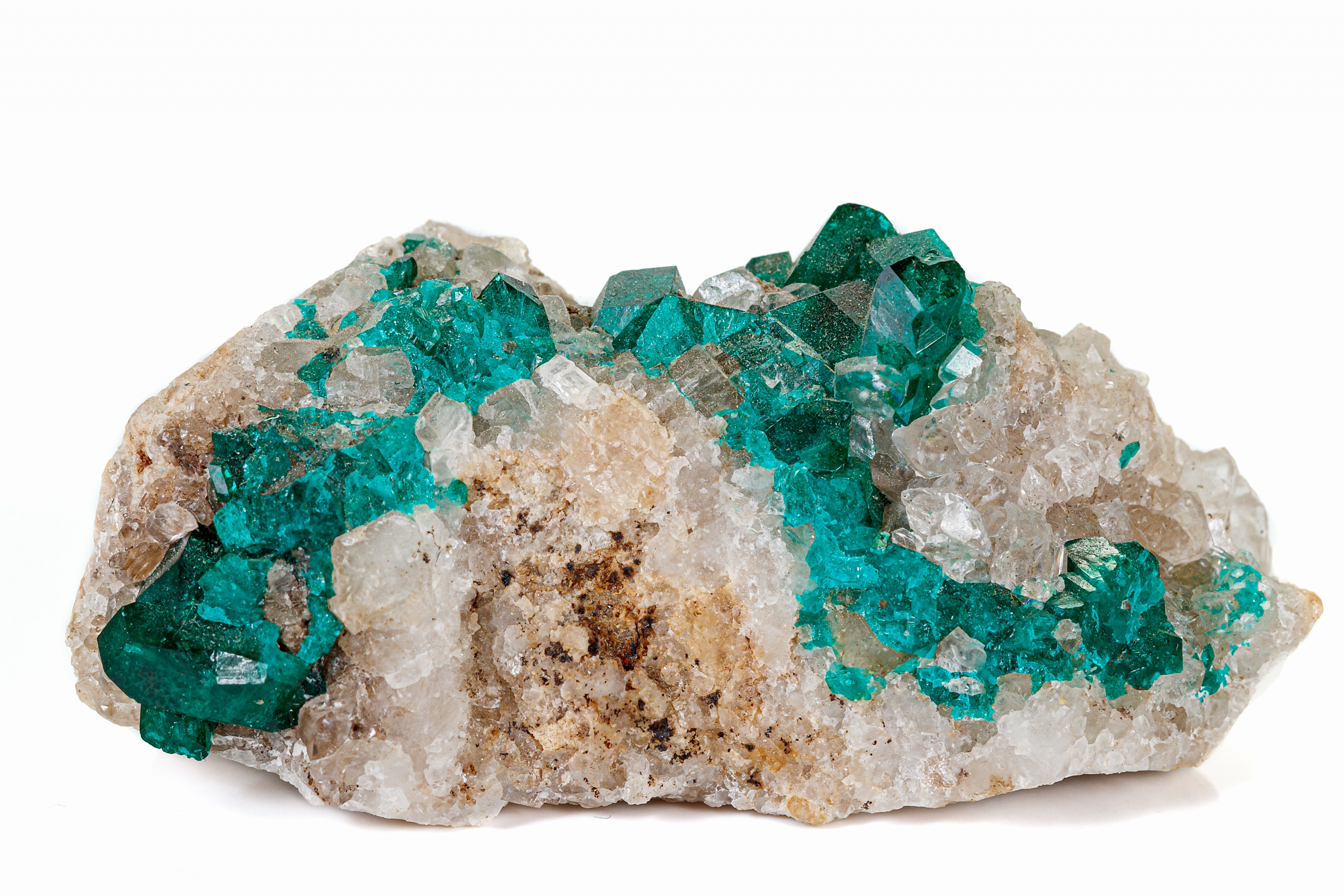
Here’s the part that trips people up: two minerals can be chemically unrelated and still look similar because their lattices happen to organize atoms in a comparable way, and two specimens of the exact same mineral can look nothing alike because the lattice got interrupted along the way. Azurite is a good case study — it has its own well-defined monoclinic crystal system and will form sharp, glassy, tabular crystals when it grows slowly and undisturbed, which is part of why a crystal like this one reads as strikingly geometric rather than as a shapeless blob of blue. Compare that to something like botryoidal hematite, which grows as rounded, grape-like clusters instead of sharp crystal faces at all — same rule (atoms still stacking in a fixed lattice at the microscopic level) but a growth habit that hides the geometry from the naked eye. We went deeper on that specific case, including why some hematite specimens flash rainbow colors, in our piece on hematite and goethite.
Temperature, pressure, available space, and how fast the mineral-forming fluid was moving all affect the final look without changing the underlying lattice at all. A quartz crystal that grew slowly in an open pocket gets to build clean, sharp faces. One that grew fast, got crowded by neighboring crystals, or had its growth interrupted comes out stubby, distorted, or fused into a cluster — still trigonal quartz on the inside, still obeying the same atomic rulebook, just a messier expression of it. That’s why no two clusters in a flat of “the same” mineral are ever identical, even though every individual crystal in the flat is still following one fixed geometric law.
Why this matters more than it sounds like it should
Crystal habit is one of the first things a mineralogist (or a careful seller) uses to identify a specimen, because it’s harder to fake than color and more consistent than size. A rhombohedral cleavage pattern is a strong tell for calcite regardless of whether the piece is honey-gold, clear, or pink — we walked through that exact specimen in our post on Ohio calcite. A double termination is a strong tell that a quartz crystal grew freely rather than attached to matrix, which is most of what separates a Herkimer-style diamond from an ordinary rock-shop quartz point, something we go into in more detail in the Herkimer diamond deep dive. Even the bowtie shape in stilbite tells you something real about how it grew, which we cover in the stilbite post.
None of this requires taking anything on faith. It’s the same reason table salt always forms cubes and snowflakes always come out six-sided: atoms pack the way their bonds allow them to, that packing repeats, and the repetition is what you’re holding in your hand. If you want the plainer-language version of how “rock”, “mineral,” and “crystal” relate to each other before going further down this road, that’s covered separately in our terminology breakdown.