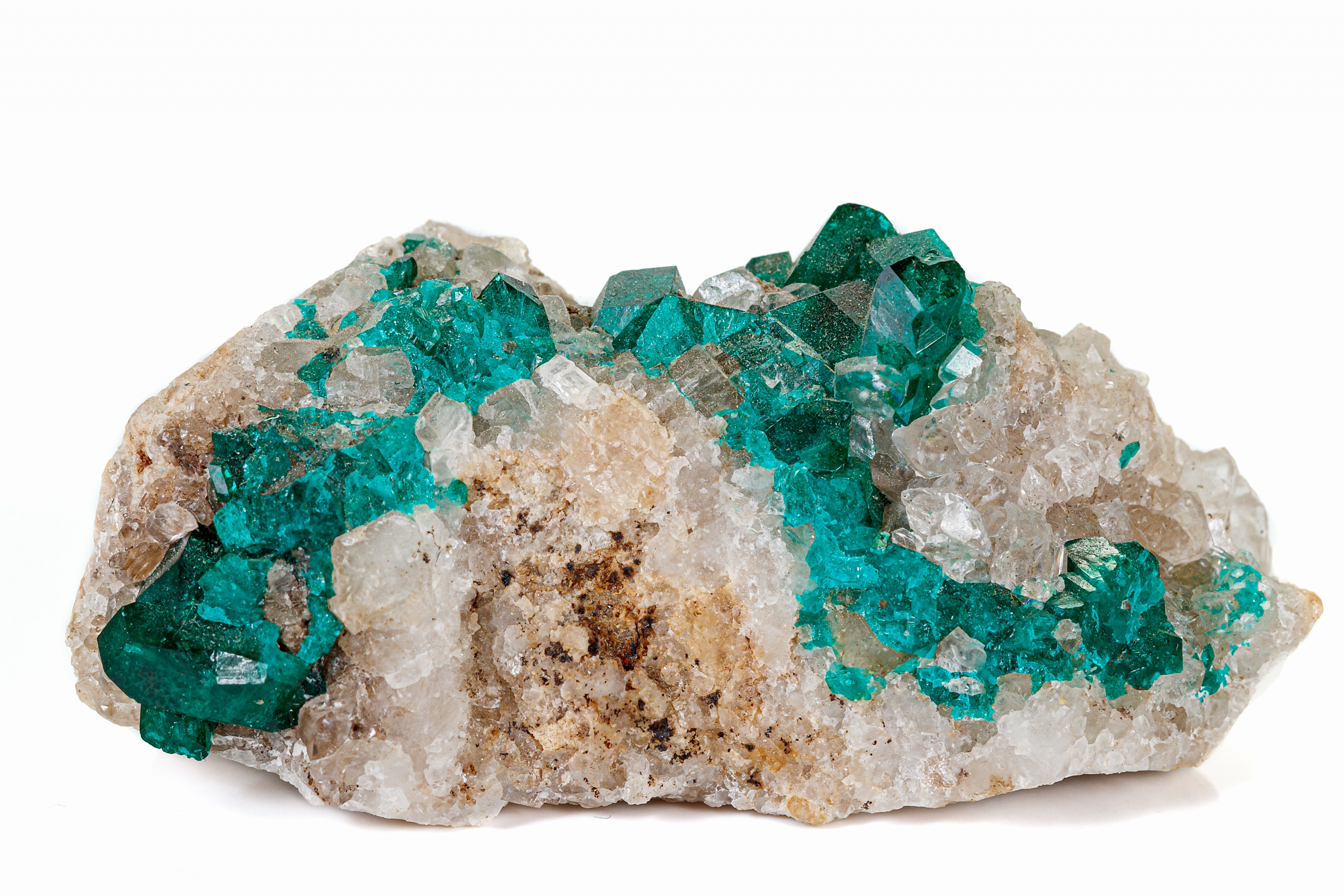

In a rock shop, almost everything on the shelf gets called “a crystal,” whether it’s a quartz point, a chunk of granite, or a slice of fossilized wood. Rock, mineral, crystal, and gemstone actually mean four different things, and knowing which is which makes it a lot easier to understand what you’re buying.
Mineral: natural, inorganic, and chemically consistent
A mineral is a naturally formed solid with a crystalline atomic structure and a defined chemical composition. Quartz is a mineral because it’s always silicon dioxide arranged in the same repeating atomic pattern, no matter where on Earth it forms. Calcite, azurite, hematite: same idea. The chemistry and internal structure are the constant; color, size, and shape can vary a lot.
Rock: minerals mixed together
A rock is an aggregate, usually of more than one mineral. If a mineral is an ingredient, a rock is the finished dish: granite is quartz, feldspar, and mica all locked together in one stone. Break a rock into smaller pieces and each mineral inside it keeps its own identity; you’re not creating new minerals, just separating the ones already there.
Crystal: a mineral that had room to grow
“Crystal” isn’t really a separate category from mineral, it describes a growth habit. When a mineral forms in open space, a cavity, a vein, a gas pocket in cooling lava, it can add atoms in a repeating pattern and grow outward into flat natural faces: cubes, points, prisms. The exact same mineral that shows sharp crystal faces in one specimen can turn up as a shapeless, granular mass somewhere else. Both are the same substance chemically. Only one of them earns the word “crystal.”
Gemstone: cut and polished to wear
A gemstone is a mineral, or occasionally an organic material like amber or pearl, that’s been cut, faceted, or polished specifically because it’s valued for beauty, durability, and rarity, and is headed for a ring or a pendant rather than a display shelf. The material doesn’t change; the intended use and the finishing work do.
Two things in our shop that technically aren’t minerals at all
Petrified wood started out organic, actual tree tissue, before groundwater slowly replaced every fiber with silica. What’s left today is made of a mineral, but it isn’t one by origin. Libyan Desert Glass goes a step further: it isn’t a mineral or a crystal by any definition, because it has no internal crystal structure whatsoever. It’s natural glass, formed almost instantly by a meteorite impact rather than crystallizing slowly like everything else on this list.
Same shop, same shelf, four different words, and now you know which one actually applies to what you’re holding.