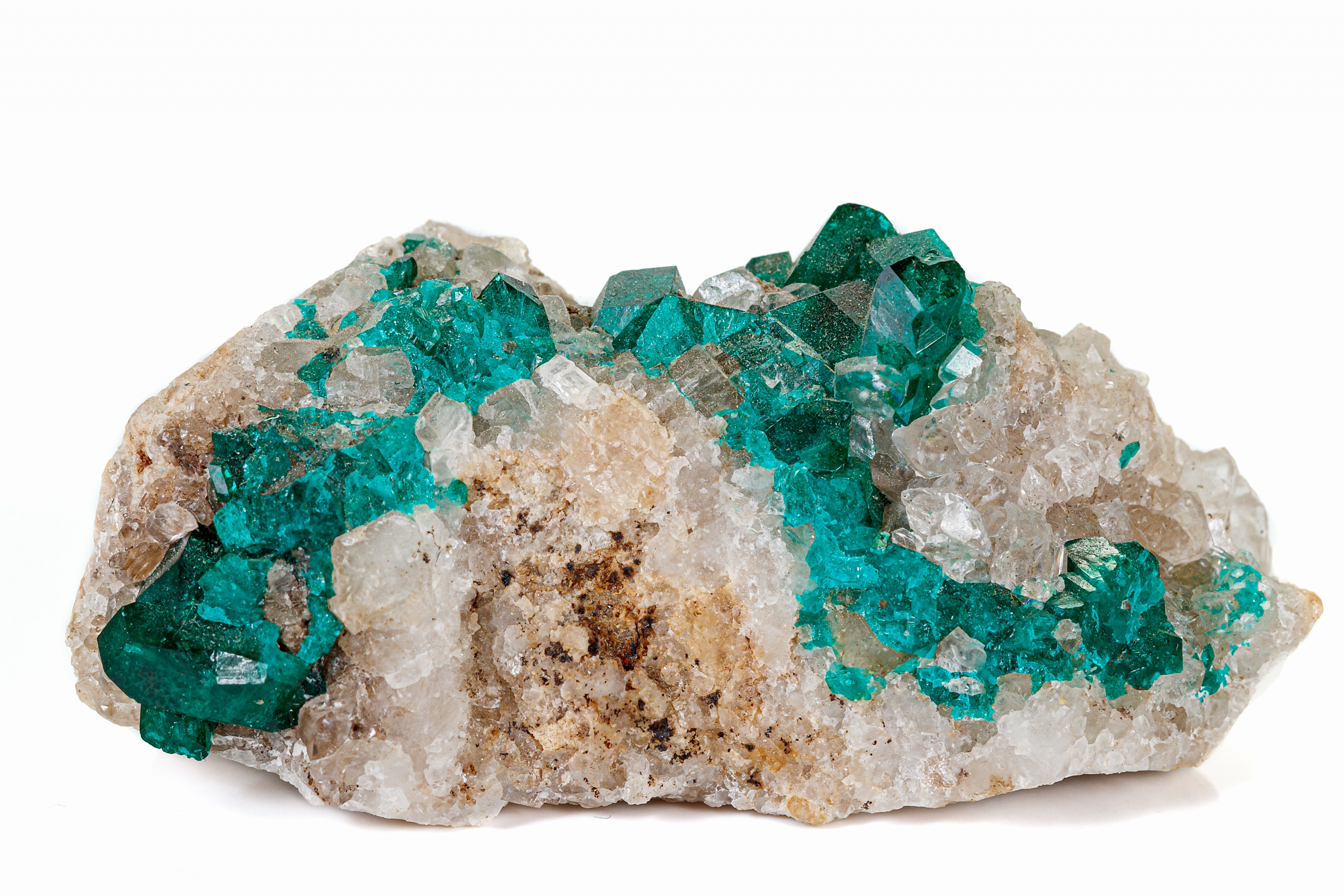
Walk into any rock shop and you’ll hear the name tossed around like it’s obvious: Herkimer diamond. It sounds like a gemstone claim, and the crystals themselves — clear, double-pointed, glinting like they were cut by a jeweler rather than grown by the earth — do nothing to talk you out of the idea. But the name is, technically, a myth. These aren’t diamonds. They’re quartz. And the real story is a lot more interesting than the marketing: a 500-million-year-old rock formation, a chemical trick involving ancient petroleum, and a naming bill that’s been quietly dying in the New York State Legislature for over a decade.
What exactly is a Herkimer diamond?
Chemically, a Herkimer diamond is nothing more exotic than silicon dioxide — ordinary quartz, the same mineral in beach sand and the crystal points sold at every rock shop in the country. There’s no carbon, no relation to actual diamond at all. The “diamond” nickname comes entirely from appearance: these crystals form with natural, mirror-flat facets and sharp points on both ends, so they arrive out of the ground already looking cut and polished. No lapidary work required.
A few things set them apart from ordinary quartz points:
- Double termination. Most quartz crystals you’ll encounter are pointed on one end and rough or broken on the other, because they grew attached to a rock wall. Herkimer diamonds are typically pointed on both ends — the signature trait that makes them instantly recognizable.
- Natural faceting. A well-formed specimen shows eighteen faces: six prism faces around the body, plus six-sided pyramidal points on each end.
- Exceptional clarity. At their best, they’re glass-clear — a rarity for quartz that grew in a rock cavity rather than a lab.
- Hardness. Like all quartz, they sit at 7 on the Mohs scale — hard enough to scratch glass, soft enough that “diamond” is still very much a stretch (diamond is a 10).
They’re technically a locality-specific variety name — true “Herkimer diamonds” come from Herkimer County, New York, and nowhere else. Visually similar double-terminated quartz does turn up in Pakistan, Madagascar, China, and a handful of other spots around the world, and dealers sometimes borrow the name for those too, but strictly speaking only the New York material earns it.
A brief history
The crystals were first documented in the late 1700s, as workmen quarrying dolostone in the Mohawk Valley kept cracking open rock and finding pockets lined with these small, glassy points. The earliest recorded name for them, dating to around 1790, wasn’t “Herkimer diamond” at all — it was “Little Falls diamond,” after the town near where they were first pulled from the ground. As more deposits turned up specifically in Herkimer County, that name won out.
The county itself is named for General Nicholas Herkimer, a Revolutionary War officer who died of wounds sustained at the Battle of Oriskany in 1777 — so in a roundabout way, every “Herkimer diamond” for sale today is named after a soldier who never saw one.
Local tradition in the region holds that Mohawk communities valued the crystals long before European settlers arrived, using them as ornamentation and trade goods. That thread of the story is passed down more than it’s documented — there isn’t a well-sourced archaeological record confirming the specifics — but it’s a piece of the area’s oral history worth acknowledging rather than glossing over.
What is well documented is the shift from casual collecting to organized mining. As prospectors got better at reading the rock and systematically breaking into crystal-bearing pockets, small commercial “fee dig” operations sprang up around Middleville and Little Falls — the same towns where recreational diggers still pay a day-use fee and swing a hammer today.
How they actually form: 500 million years in the making
This is where the story gets genuinely scientific, and it’s worth slowing down for, because most retail write-ups skip straight past it.
Herkimer diamonds grow inside the Little Falls Formation, a dolostone unit laid down in a shallow sea during the Late Cambrian — somewhere in the neighborhood of 500 million years old. That’s old enough to predate land plants and land animals entirely; this rock was already ancient by the time anything was crawling out of the ocean.
Within that dolostone are small hollow pockets called vugs. Over an almost incomprehensible span of geologic time, silica-rich groundwater seeped into these cavities and slowly deposited quartz, crystal by crystal, layer by layer. The double termination — the feature that makes these crystals look store-bought — comes down to simple physics: a quartz crystal that grows while fully suspended in fluid inside an open cavity, never anchored to the vug wall, is free to build outward in every direction and develop a natural point on both ends. Most quartz you see elsewhere grew attached at its base to a rock surface, which is why it only points one way. A Herkimer diamond that shows no rough patches at all — no sign it ever touched the vug wall while growing — is what collectors call a “floater.”
The “how did they get so clear” question actually has a documented scientific answer. A 1992 geological study of the Little Falls Formation (Muskatt and Tollerton, published by the New York State Geological Association) used fluid inclusion analysis — essentially reading the trapped microscopic fluid bubbles inside the quartz like a thermometer — and found the crystals grew at a surprisingly low temperature, somewhere around 50°C, while buried under as much as seven kilometers of rock and sediment.
The more striking part of that research points to petroleum. The same study cites earlier work showing that organic hydrocarbon compounds — essentially ancient oil moving through the rock — significantly increase how much silica can dissolve in groundwater. The leading theory is that this slow-motion interaction with hydrocarbons is exactly what let these crystals grow so large and so clear: not a rushed, chaotic crystallization, but an unusually patient one, chemically encouraged by the same organic material that later got trapped inside the crystals as the black inclusions collectors prize. The flaw, in other words, may be the whole reason for the beauty.
One more piece of the puzzle: dolostone is considerably more soluble than quartz. As millions of years of rainwater, acidic groundwater, and — more recently — Pleistocene glaciation wore away at the surrounding rock, the harder, more chemically stable quartz crystals were gradually freed from their pockets and washed into soil and streambeds. That’s why Herkimer diamonds can be found two different ways: breaking open intact rock to reach a sealed vug (“cavity mining”), or simply scanning the ground and creek beds after a hard rain, where loose crystals the dolostone has already released tend to surface.
What’s inside: inclusions and special types
Part of what makes this material fun to collect is what got trapped inside while it was forming.
- Anthraxolite (pyrobitumen). A solid black hydrocarbon — essentially fossilized, polymerized petroleum residue. This is the most common inclusion, showing up as black specks, streaks, or coatings, and it’s the same organic material the 1992 research links to the crystals’ unusual clarity in the first place.
- Enhydro crystals. Rare specimens that sealed in a pocket of ancient liquid — sometimes with a visible bubble that actually moves when you tilt the crystal. A real feature, not a marketing flourish.
- Phantom crystals. A faint ghost-outline of an earlier growth stage, visible inside the finished crystal, usually marked by a thin layer of hydrocarbon dust from a pause in growth before the quartz kept building around it.
- Floaters vs. contacts. A “floater” grew fully suspended and shows no rough patches; a crystal with one or more bumpy, frosted areas where it touched the vug wall during growth is called a “contact” — a natural growth feature, not damage.
- Scepter crystals. An uncommon form where a wider termination sits on top of a narrower crystal “handle” — a specific growth-stage anomaly that shows up more often in the Little Falls district than most other quartz localities.
Crystals also frequently form alongside dolomite, calcite, pyrite, sphalerite, and galena within the same vugs — so a broken-open pocket can turn up more than just quartz.
The science is still active
This isn’t a closed chapter of 19th-century geology. The Little Falls Formation is still being studied. A dedicated research effort, HerkimerHistory.com, has been systematically documenting the district since 1992 — a genuine case of citizen science working alongside professional mineralogy to explain why crystal character varies so much from pocket to pocket. And as recently as 2025, a peer-reviewed article on a specific Little Falls-area mine was published in Rocks & Minerals, a respected mineralogical collectors’ journal — proof that people are still actively researching this deposit, not just mining it.
Not (quite) the state mineral
Here’s a fact that trips up a lot of write-ups on this topic: Herkimer diamond is not New York’s official state mineral. New York doesn’t currently have one (its official state gemstone is garnet, designated back in 1969). A bill to name the Herkimer diamond as the state mineral has been introduced in the New York State Senate repeatedly — across multiple sessions going back to at least 2009 — and has died in committee every single time. It’s a popular idea that just hasn’t become law, which is a more interesting fact than the incorrect version most sites repeat.
Where to dig your own
Herkimer County still runs on this deposit. A handful of fee-dig operations around Middleville, Herkimer, and Little Falls let visitors hammer their way into vuggy dolostone and keep whatever they find:
- Herkimer Diamond Mines (paired with the Herkimer Diamond KOA Resort) — the largest and most tourist-friendly operation, with an open quarry area, a sluice station for kids, and a rebuilt visitor center after a 2017 fire.
- Ace of Diamonds Mine — a smaller, no-frills quarry about 500 meters from Herkimer Diamond Mines, generally favored by more serious, dedicated diggers.
- Crystal Grove Diamond Mine & Campground — a family-run site just west of the county line with three separate collecting areas, including a sifting station that makes it a solid option for younger kids.
All of them run on the same basic model: pay a day-use fee, bring or rent basic tools (a hammer, chisel, safety glasses, and a bucket cover the essentials), and keep everything you find. Three techniques cover most of what you’ll do out there: hammering into exposed vuggy rock (“find and break”), scanning loose rubble and creek beds after rain (“scavenger” collecting, since erosion is constantly freeing new crystals on its own), and working larger pockets open with wedges to pull out an entire cache at once (“cavity mining”). Digging season generally runs April through October.
A couple of odd footnotes
The formation these crystals grow in is roughly 500 million years old, older than land plants, older than dinosaurs, older than anything that ever walked on solid ground. In October 2018, Meghan Markle wore a full set of Herkimer diamond jewelry to Princess Eugenie’s royal wedding, an 18k gold bracelet, four rings, and earrings by British jeweler Pippa Small, which is about as close as the stone has come to a moment in the international spotlight. And there’s no verified record for the largest one ever found, just plenty of informal claims and no settled answer. Most gem-clarity specimens run under two inches; anything bigger that’s still clear and undamaged is unusual.
Half a billion years of quiet chemistry, a county named for a soldier, and a name that never quite became official no matter how many times someone tried — that’s what’s sitting in the bins labeled “Herkimer diamond” in our shop. Have a look through what we’ve got in stock below.