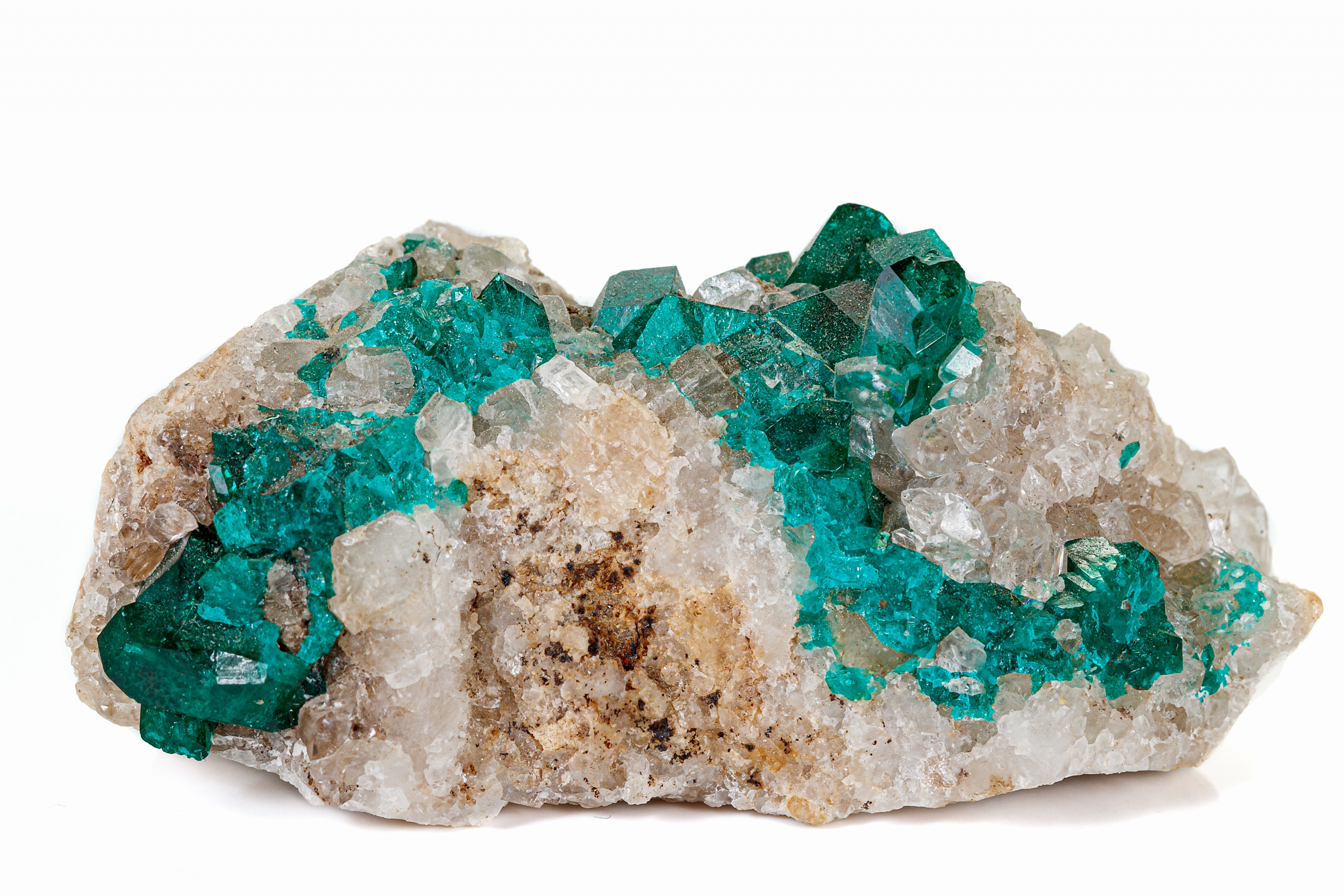

If you picked a random cubic metre of continental crust and analysed it, the most abundant mineral in it would almost certainly be feldspar. Roughly 60 percent of the crust is feldspar. It is, by a wide margin, the most common mineral group on the planet, and almost nobody collects it.
Two families, one framework
Feldspar is a group, not a species. All feldspars are framework aluminosilicates, built from a three-dimensional net of linked silicon-oxygen and aluminium-oxygen tetrahedra with larger cations sitting in the gaps. Which cation sits in those gaps splits the group in two.
The alkali feldspars take potassium, and sometimes sodium: orthoclase, microcline and sanidine, chemically similar but differing in how ordered the aluminium and silicon are in the framework, which in turn depends on how fast the rock cooled.
The plagioclase feldspars run on a continuous chemical slide from albite, the sodium end, to anorthite, the calcium end, with named waypoints in between. There is no sharp boundary. Plagioclase is a solid solution series, meaning the composition varies continuously, and a single crystal can be chemically zoned from core to rim, recording the changing chemistry of the magma it grew in.
Granite is mostly this
A granite is, by definition, mostly quartz and feldspar with some mica. Take the feldspar out of granite and you do not have granite any more. The pink and white blocky grains in any polished granite countertop are alkali feldspar and plagioclase respectively, and the glassy grey grains between them are quartz.
Feldspar also sets the reference point at 6 on the Mohs scale, where Mohs used orthoclase. That places it just below quartz, which turns out to matter enormously.
Why every beach is quartz
Here is the part that is genuinely satisfying. If feldspar is 60 percent of the crust and quartz is around 12 percent, why is sand overwhelmingly quartz?
Because feldspar does not survive. Feldspar weathers chemically, reacting with water and dissolved carbon dioxide to break down into clay minerals, mostly kaolinite, while releasing potassium, sodium and calcium into solution. Quartz, being pure silica with no weak links in the framework, does essentially nothing. Over geological time, every river system on Earth performs a continuous separation: feldspar becomes clay and ends up as mudstone and shale, quartz survives as sand.
So the abundance of quartz beaches and the abundance of clay soils are the same fact, seen from two ends. This is the rock cycle doing chemistry rather than just moving material around.
The feldspars people do collect
Collectors do buy feldspar, they just call it something else. Moonstone and labradorite are both feldspars, and their glow comes from microscopic internal layering scattering light, explained in the physics behind the glow. Amazonite is a green microcline. Sunstone is a plagioclase with copper or hematite platelets.
In a pegmatite, feldspar crystals can reach metres across. The largest single crystals ever documented on Earth are feldspars.
Feldspar as matrix
Where feldspar shows up most often in a collection is as the rock a better-known mineral is sitting on. Our Herkimer diamond quartz cluster with feldspar is exactly that: the quartz is the headline, the feldspar is the context, and the context is what tells you the specimen is genuinely in place rather than loose. Our New Jersey quartz comes out of the same kind of association. The argument for why that matters is in what on matrix actually means.
Industrially invisible, industrially essential
Feldspar is mined in millions of tonnes a year for ceramics and glass, where it acts as a flux, lowering the melting point of the batch. It is in tile, sanitaryware, tableware, glass fibre and abrasives. Like quartz, its ordinariness is precisely what makes it useful.
Sixty percent of the crust, the reason beaches are quartz, the reason soil is clay, and the thing most of your kitchen is glazed with. Not bad for the mineral nobody puts on a shelf.