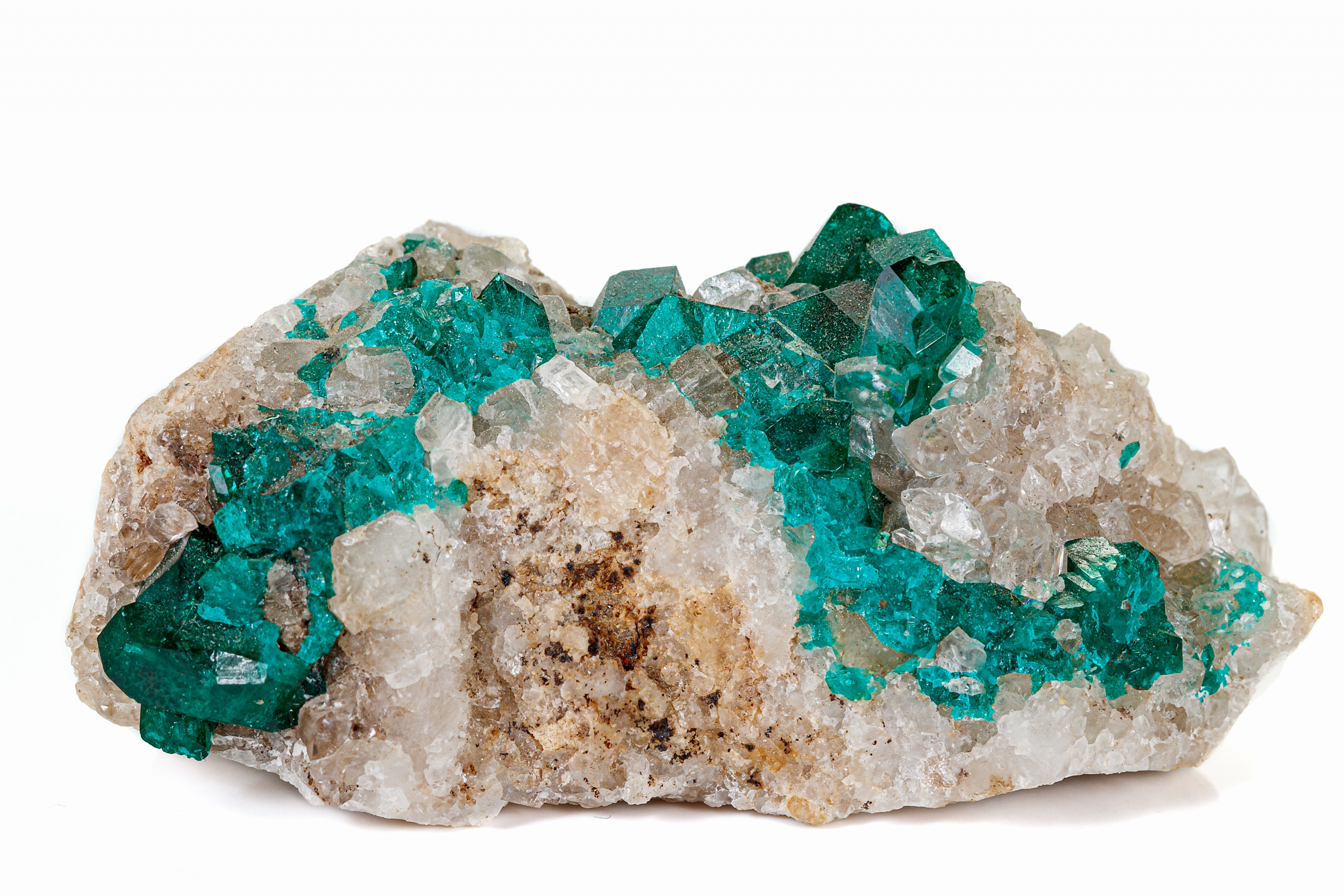

Quartz’s industrial importance has almost nothing to do with jewelry or display specimens, and nearly everything to do with two much less glamorous facts: it’s chemically simple, silicon dioxide, and it’s the single most abundant mineral in the Earth’s continental crust after feldspar.
From sand to glass
Ordinary glass is made primarily from silica sand, essentially finely ground quartz, melted at high temperature with soda ash and limestone to lower the melting point and improve durability. The purity of the quartz sand used directly affects the glass’s clarity and color, which is why certain quartz-rich sand deposits around the world are quarried specifically for glassmaking rather than for specimen or construction use, distinct feedstock for a distinct industry.
From sand to silicon chips
A much smaller, far more purified fraction of quartz feeds an entirely different industry: semiconductor-grade silicon. Extremely high-purity quartz is chemically reduced to extract elemental silicon, which is then further refined to the near-perfect purity required to grow the silicon crystals that become computer chips, a purification process with essentially zero tolerance for the trace elements that make natural quartz specimens colorful in the first place. It’s a genuinely different application than quartz’s piezoelectric use in timing devices, one uses quartz’s chemistry as a raw material to be transformed entirely, the other uses an intact quartz crystal’s own physical properties directly.
Between glassmaking, silicon production, and countless other industrial roles, quartz’s economic footprint dwarfs the mineral specimen trade by an enormous margin, most of the quartz mined worldwide never becomes a display piece at all, it becomes windows, concrete aggregate, and the chips inside nearly every modern electronic device.