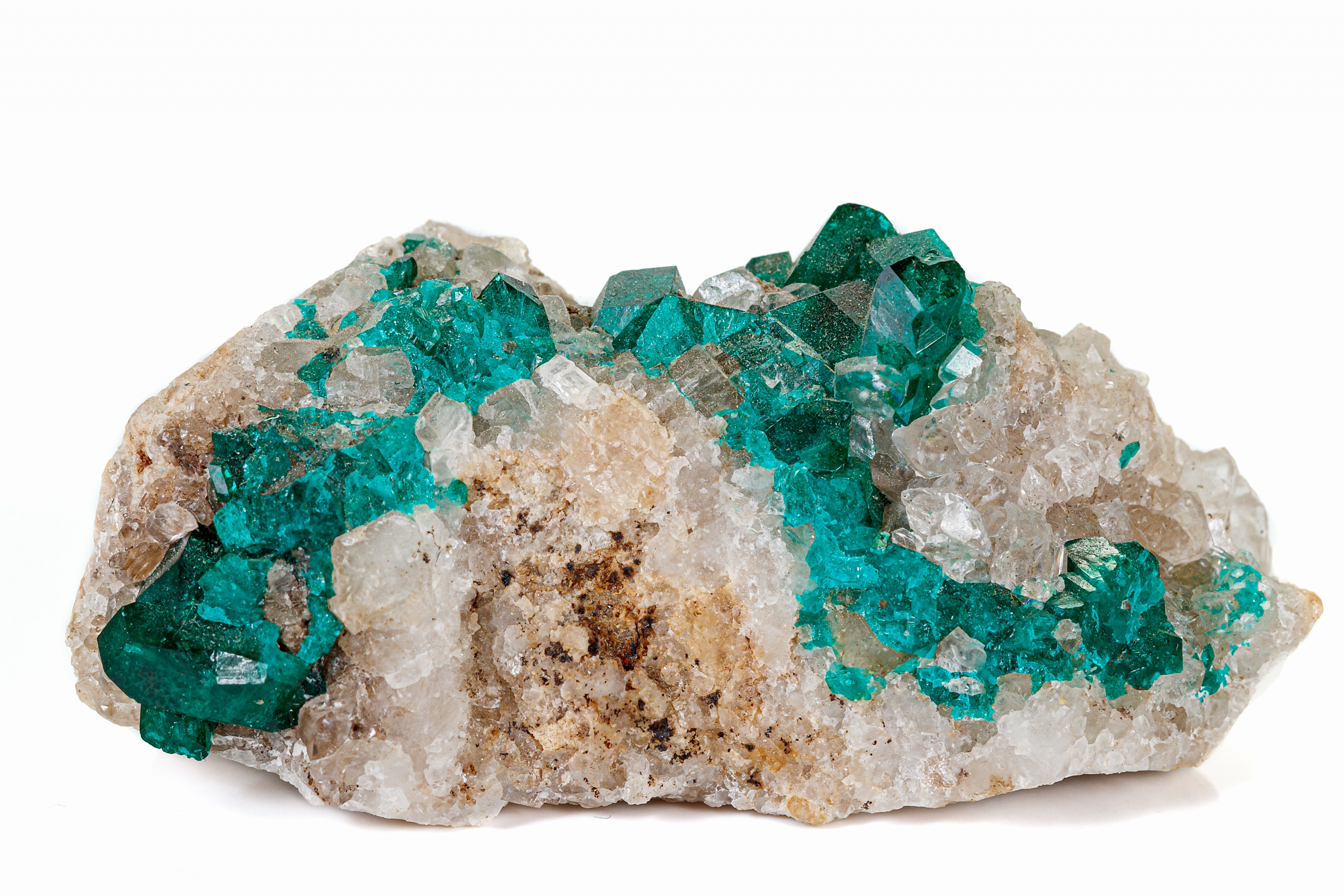

Two minerals sitting on the same specimen is ordinary. Two minerals sitting on the same specimen where every crystal of the second is oriented the same way relative to the first is something else. That is epitaxy, and it is one of the more satisfying things to spot on a shelf.
Lattice matching
Starting a crystal from scratch is energetically expensive, as set out in nucleation. One way to cheat is to start on a surface whose atomic spacing happens to be close to your own.
If the host crystal presents a face where atoms sit at intervals that roughly match the spacing the newcomer wants, the newcomer can build directly on it with minimal strain. The cost of nucleation drops sharply, but only in that one orientation. Every crystal that forms this way inherits an alignment from its substrate.
The two minerals need not be related chemically. All that matters is that some plane in one lattice is dimensionally close to some plane in the other.
Classic natural examples
Rutile needles growing on hematite in strict threefold alignment, producing the star pattern collectors call rutile stars. Staurolite on kyanite, both aluminium silicates. Albite on orthoclase. Chalcopyrite on tetrahedrite. Hematite plates on quartz faces at a fixed angle.
The tell is repetition. One crystal in a particular orientation is chance. Twenty crystals all in the same orientation, or in a small set of symmetry-equivalent orientations, is epitaxy.
How to tell it from the things it resembles
Three ideas get confused constantly.
Epitaxy is two different minerals, the second nucleating on the first in a defined orientation, both growing as separate crystals.
Twinning is one mineral, two or more parts of the same crystal related by a symmetry operation, established during growth. Same species, always.
Exsolution is a single crystal unmixing internally after it has already formed, with the second phase appearing inside the host rather than on it.
And simple intergrowth, where two minerals grew together with no particular relationship, is none of the above. That is the general case described in two minerals, one stone, and it is far more common than true epitaxy.
Why the orientation matters more than the mineral
Epitaxy tells you the sequence. The substrate had to exist first, and had to present a clean face, and the second mineral had to arrive while that face was still exposed. It pins down the order of events in a way that a random association never can.
Our Herkimer cluster with feldspar shows quartz sitting on a feldspar-bearing matrix, and our New Jersey mineral mix on matrix shows several species sharing one rock face. Whether any given association is genuinely epitaxial takes measurement rather than eyeballing, so the honest description is intergrowth unless the alignment has actually been checked. That reticence is the same principle argued in provenance and paperwork and what on matrix means.
The technology you are reading this on
Epitaxy stopped being a curiosity in the 1960s. Essentially every semiconductor device made today is built by growing crystalline layers on a substrate wafer in perfect lattice alignment, by molecular beam epitaxy or chemical vapour deposition. LEDs, laser diodes, solar cells, high-frequency transistors, the processor in your phone.
The engineering problem is lattice mismatch: if the layer and the substrate differ too much in spacing, strain builds and defects form. Entire materials industries exist to find or engineer substrates that match. Silicon carbide and sapphire, which is corundum, are both used as substrates for exactly this reason.
Growing a synthetic crystal on a seed in controlled orientation is the same idea, covered in synthetic versus natural. A mineral habit turned into a manufacturing process.