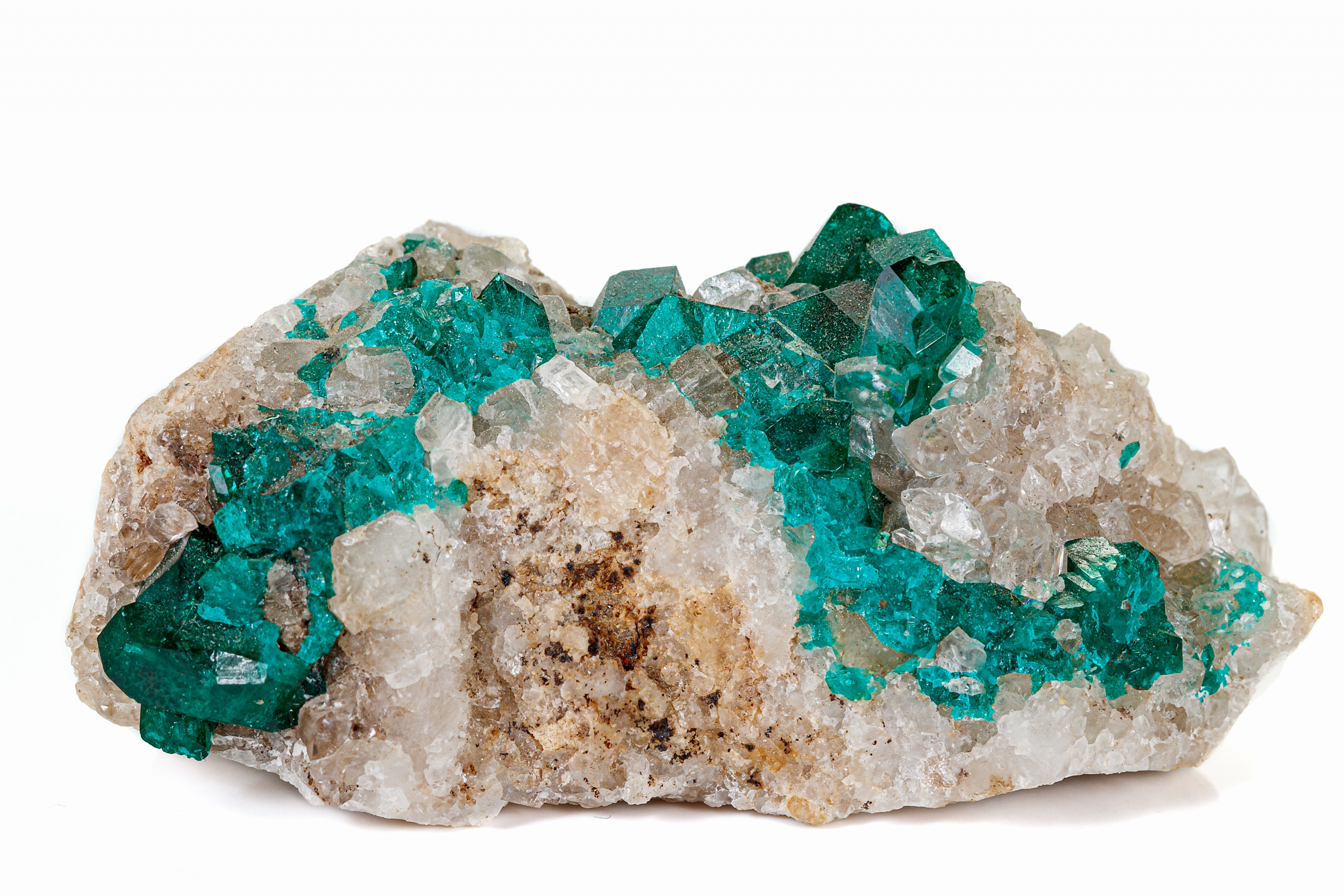

A crystal that formed at high temperature can, as it cools, decide that it no longer wants to be one mineral. It cannot melt and start again. Instead it separates internally, growing lamellae of a second composition inside itself while remaining a solid throughout. This is exsolution, and once you know it exists you start seeing it everywhere.
Why a crystal unmixes
Many minerals form solid solution series, where two end-member compositions mix freely in any proportion. Plagioclase feldspar is the standard example, running continuously from sodium-rich to calcium-rich.
Mixing is easiest when the crystal is hot, because thermal vibration is large enough that ions of different sizes can share sites comfortably. As temperature drops, the lattice tightens and mismatched ions become an increasing strain. Below a certain temperature the crystal lowers its total energy by segregating: sodium-rich regions here, potassium-rich regions there.
Atoms diffuse short distances through the solid and organise into fine alternating lamellae. No melting, no fluid, no dissolution. Just internal reorganisation, typically on scales from nanometres to millimetres.
Perthite
The classic case. Alkali feldspar crystallising at magmatic temperatures happily takes both potassium and sodium. On cooling it unmixes into potassium-rich and sodium-rich lamellae, producing the streaky, wispy texture called perthite, visible with a hand lens in a great many granites.
Once you recognise it, perthitic texture becomes a thermometer of sorts. Coarse lamellae mean slow cooling, which gave atoms time to diffuse far. Extremely fine lamellae mean fast cooling. The same logic that governs grain size in volcanic versus plutonic rocks operates here inside a single crystal.
Feldspar appears as matrix in our Herkimer diamond cluster with feldspar, which is a good excuse to look closely at a rock most people ignore.
This is why moonstone glows
Moonstone and labradorite are feldspars, and their optical effects are exsolution effects. When the alternating lamellae are on the scale of the wavelength of visible light, they scatter and interfere with it rather than simply transmitting it.
In moonstone that produces adularescence, the floating blue-white sheen. In labradorite it produces labradorescence, the flashes of blue, green and gold. Both are structural colour, generated by geometry rather than pigment, which sets them apart from every colour discussed in trace elements. The optics are laid out in the physics behind the glow.
So one of the most prized optical effects in gemstones is a crystal failing to stay homogeneous.
The pyroxene version
Pyroxenes do it too, exsolving calcium-rich and calcium-poor lamellae on cooling. Petrologists measure the compositions of the exsolved pairs to calculate the temperature at which separation stopped, which gives a real number for the cooling history of a rock body. The crystal records its own thermal history internally.
And in meteorites
The Widmanstätten pattern in iron meteorites is exsolution on a spectacular scale: kamacite lamellae separating out of taenite as a nickel-iron core cooled at a few degrees per million years. The pattern cannot be faked because the cooling rate cannot be reproduced, which makes it a diagnostic test, as noted in telling a space rock from a hot rock.
Not a pseudomorph, not a twin, not an inclusion
Worth keeping these apart. A pseudomorph is replacement from outside. Twinning is a symmetry relationship established during growth. An inclusion is a foreign crystal trapped during growth. Exsolution is none of these: the second mineral was never separate, and was never anywhere else. It came out of the host, from the inside, after the crystal had already finished growing.