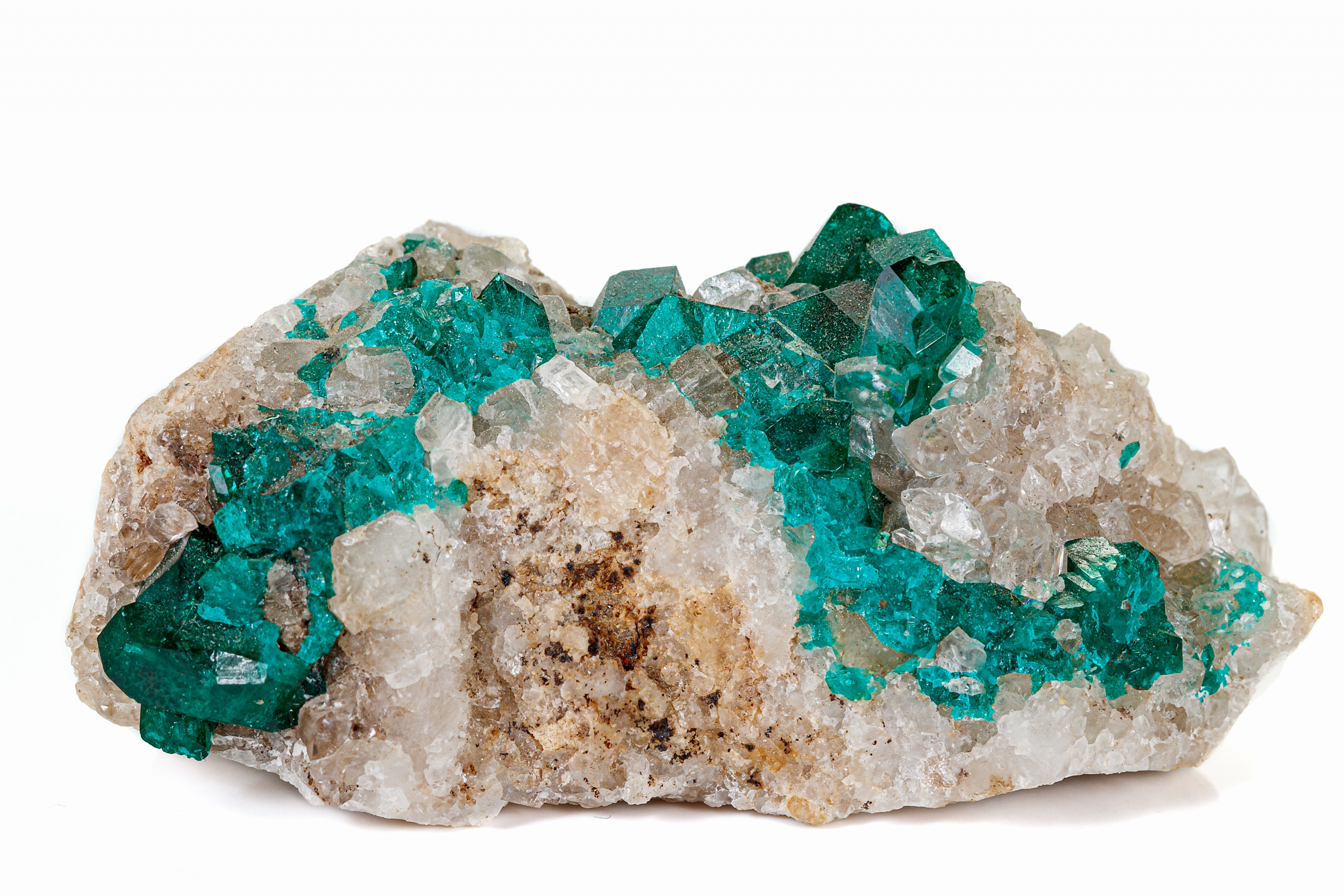

Two cavities in the same rock, filled by the same fluid, at the same time. One produces a single quartz crystal the length of your forearm. The other produces a carpet of glittering crystals none bigger than a grain of sugar. The difference is not how much silica was available. It is how many crystals got started.
Starting is harder than growing
Adding an atom to an existing crystal face is easy. Starting a brand new crystal from nothing is not. A cluster of a few dozen atoms has a very high ratio of surface to volume, and surface costs energy, so tiny clusters tend to redissolve as fast as they assemble.
Only once a cluster passes a critical size does growing become energetically favourable. Below that threshold the cluster dies, above it the crystal takes off. That threshold is the nucleation barrier, and getting over it requires the solution to be supersaturated: holding more dissolved material than it comfortably can.
The trade-off that decides everything
Here is the whole story in one sentence. Nucleation rate and growth both feed on the same supersaturation, and once a crystal starts growing it consumes the supersaturation that would have allowed more crystals to start.
High supersaturation means the barrier is easy to clear, so enormous numbers of nuclei form almost simultaneously. They all compete for the same limited dissolved material and all stay small. You get a fine-grained crust.
Low supersaturation means only a handful of nuclei ever form, often on a favourable surface defect. They then have the entire supply to themselves for as long as the fluid keeps circulating. You get a few large crystals.
Slow and barely saturated makes giants. Fast and heavily saturated makes powder.
What that looks like on a shelf
Our large quartz point and the other large point are low-nucleation outcomes: few starts, long uninterrupted growth, room to develop faces.
Our druzy matrix specimen and golden Herkimer druzy are the opposite: a sudden pulse of supersaturation across a whole surface, thousands of simultaneous starts, and a sparkling crust where nothing got large. The full explanation of that crust is in druzy.
Neither is better. They are two readings on the same dial.
The extreme cases
The Cave of Crystals at Naica, Mexico is the low-nucleation limit made absurd: selenite beams up to eleven metres long, grown from water held for hundreds of thousands of years within a degree or two of the gypsum-anhydrite transition temperature, meaning supersaturation was minute and nucleation almost never happened. A handful of crystals, unlimited time, unlimited supply. The story is in the Cave of Crystals.
At the other end, obsidian cools so fast that nucleation never gets organised at all and the melt freezes into glass with no crystal structure.
Pegmatites are the intermediate marvel: giant crystals despite a fairly ordinary setting, because dissolved water and fluxing elements make the melt so mobile that atoms diffuse easily to existing crystals rather than clustering into new ones.
Seeds and surfaces
Nucleation gets far easier when there is something to start on. A rough surface, a dust particle, a pre-existing crystal face: all lower the barrier, because the new cluster does not have to create all of its own surface. This is heterogeneous nucleation, and it is why crystals so often line a cavity wall rather than floating in the middle.
Taken to its logical end, a new crystal will sometimes nucleate on a specific face of a different mineral in a specific orientation, which is epitaxy.
Reading a specimen backwards
Crystal size is data. A cluster of uniform small crystals says one fast event. A few large crystals say slow, steady, long. Small crystals scattered on top of large ones say two separate episodes, the second faster than the first. That is the same forensic habit described in reading a specimen without a label, applied to size rather than shape.