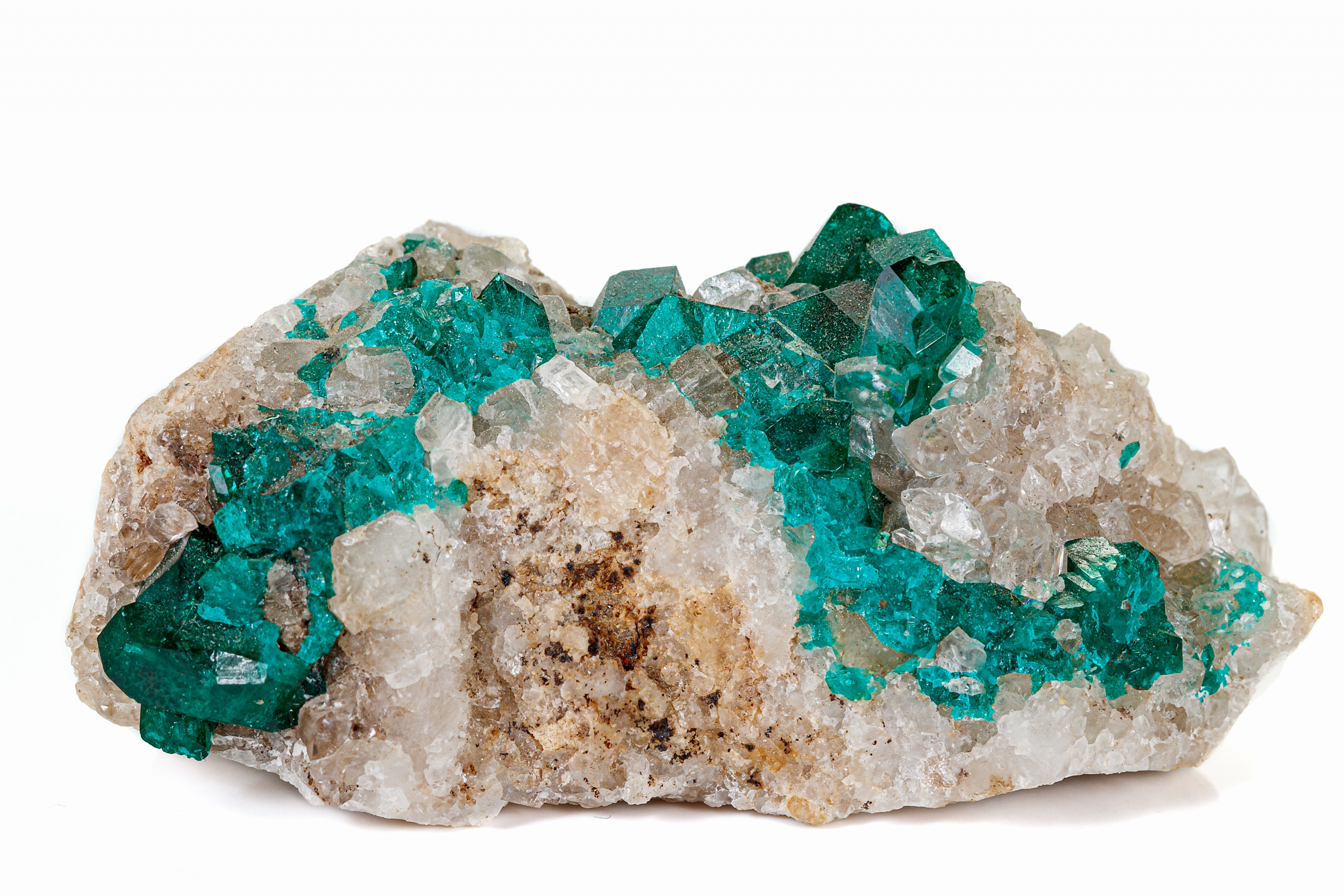

Hold a quartz point and you can see the crystal. Hold an agate and you cannot see anything at all, just a smooth translucent mass. They are the same mineral. The difference is the size of the crystals, and it changes almost every practical property.
Microcrystalline quartz
Chalcedony is the umbrella term for quartz composed of crystals too small to see without magnification, often submicroscopic fibres bundled together. The chemistry is silicon dioxide, identical to the clear quartz point on the shelf. What changed is that instead of a few crystals growing slowly with room to develop faces, countless nuclei formed at once from a silica-rich gel or solution and grew into each other.
Nearly every familiar semi-precious quartz is chalcedony under another name:
- Agate — banded chalcedony.
- Onyx — agate with straight, parallel bands.
- Carnelian — translucent orange to red, coloured by iron oxide.
- Chrysoprase — apple green, coloured by nickel.
- Jasper — opaque, heavily included with iron and clay.
- Flint and chert — sedimentary, dense, often nodular.
- Petrified wood — usually chalcedony that replaced cell structure, which is why our Long Island petrified wood takes such a good polish.
Why the fibres matter
Interlocked microscopic fibres make chalcedony considerably tougher than single-crystal quartz, even though both sit at Mohs 7 for hardness. A big quartz crystal can be split or chipped along a weakness. A mass of interlocking fibres has no continuous plane to fail along, so it resists breaking. This is the hardness versus toughness distinction in its clearest form.
That toughness, combined with a predictable conchoidal fracture, is why flint and chert dominated toolmaking for two million years. You can strike a flake with a sharp, controllable edge. Try that with a block of granite and you get gravel.
How agate banding actually forms
Agate typically fills a cavity, usually a gas bubble in volcanic rock, the same kind of void described in basalt’s hidden cavities. Silica-rich fluid enters, and deposition proceeds inward from the cavity wall in successive layers.
The bands record changes in the fluid: impurity content, iron oxidation state, silica concentration, rate of supply. What makes agate banding distinct from the rhythmic layering in malachite is the fortification pattern, where bands follow the irregular outline of the original cavity rather than forming smooth concentric circles.
Often the centre never fills with chalcedony at all, and the last of the fluid grows visible quartz or amethyst crystals into the remaining space. That is a geode, and the terminology is sorted out in geodes, nodules and vugs. Agate and geode are the same process caught at different stages.
A note on dyed agate
Chalcedony is porous at the microscopic level, which makes it unusually easy to dye. The vivid blue, magenta and lime agate slices sold everywhere are dyed, and that is fine when it is disclosed. The bands take up dye unevenly because they differ slightly in porosity, which is precisely why the colours look so striking. Natural agate colours are mostly greys, whites, browns, reds and soft blues. Everything you need to spot the difference is in dyed, heated or coated.
The overlooked half of quartz
Collectors chase visible crystals, which is understandable. But chalcedony is the form of quartz that armed the Stone Age, that preserves fossil wood cell by cell, and that carries the most detailed growth record of any common mineral. Not bad for the version you cannot see.