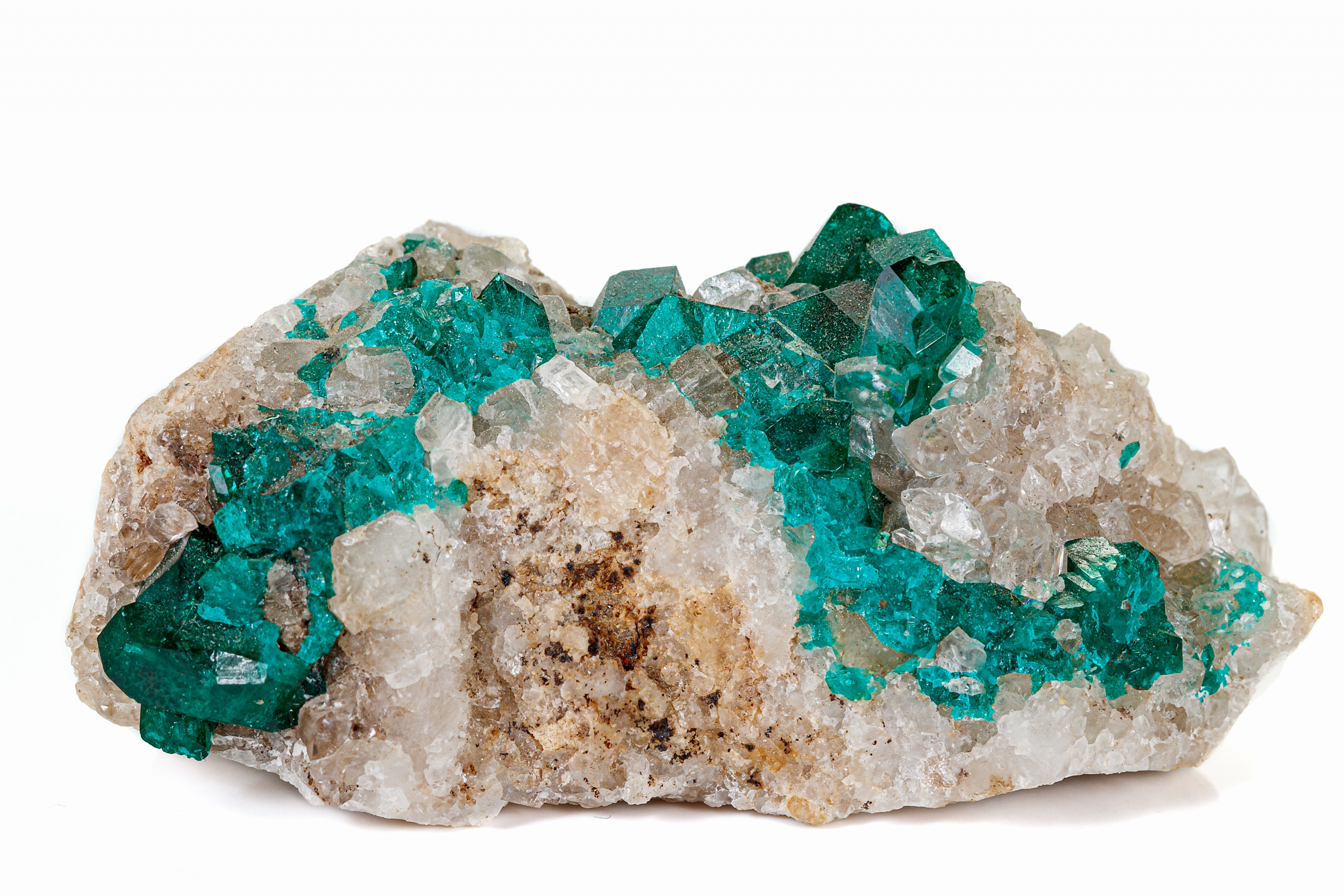

Put a quartz point, a quartz cluster, and a piece of druzy quartz side by side and they can look like three unrelated minerals. Same chemical formula, same crystal system, wildly different shapes. Mineralogists have a word for that variation: habit, meaning the characteristic external shape a mineral tends to grow into under a given set of conditions. It’s not the mineral changing, it’s the growing conditions changing what the mineral has room and time to do.
Space, speed, and what’s already there
A crystal’s habit comes down mostly to how much open space it had to grow into, how fast it grew, and what surface it started growing on. Give quartz a wide-open cavity and enough time, and you get a large, well-formed single point like this one, faces flat, termination sharp, because nothing interrupted its growth. Crowd a lot of quartz seeds onto a small patch of host rock at once, competing for the same limited space, and instead of one large crystal you get dozens of smaller ones packed shoulder to shoulder, which is the basic recipe for a druzy crust like the one covering this golden Herkimer cluster.
The same rules, radically different results
Habit terminology gets specific: prismatic for elongated, column-like crystals, druzy or drusy for a crust of small crystals coating a surface, massive for material with no obvious external crystal faces at all, botryoidal for rounded, grape-like clusters. None of these are separate minerals or separate qualities of “how good” a specimen is, they’re just different answers to the same growth question, and a single locality can produce more than one habit depending on exactly where in a cavity a given crystal happened to form.
What it’s actually telling you
Reading habit is one of the more useful, low-effort skills for figuring out how a piece formed before you know anything else about it. A large clean point suggests slow growth in open space. A dense druzy crust suggests a crowded, fast-nucleating pocket. A specimen where several habits show up on one piece, points along one edge, druzy texture along another, is usually recording a change in growing conditions partway through. For the vocabulary that separates “rock” from “mineral” from “crystal” in the first place, our terminology breakdown covers the layer of definitions habit builds on top of.