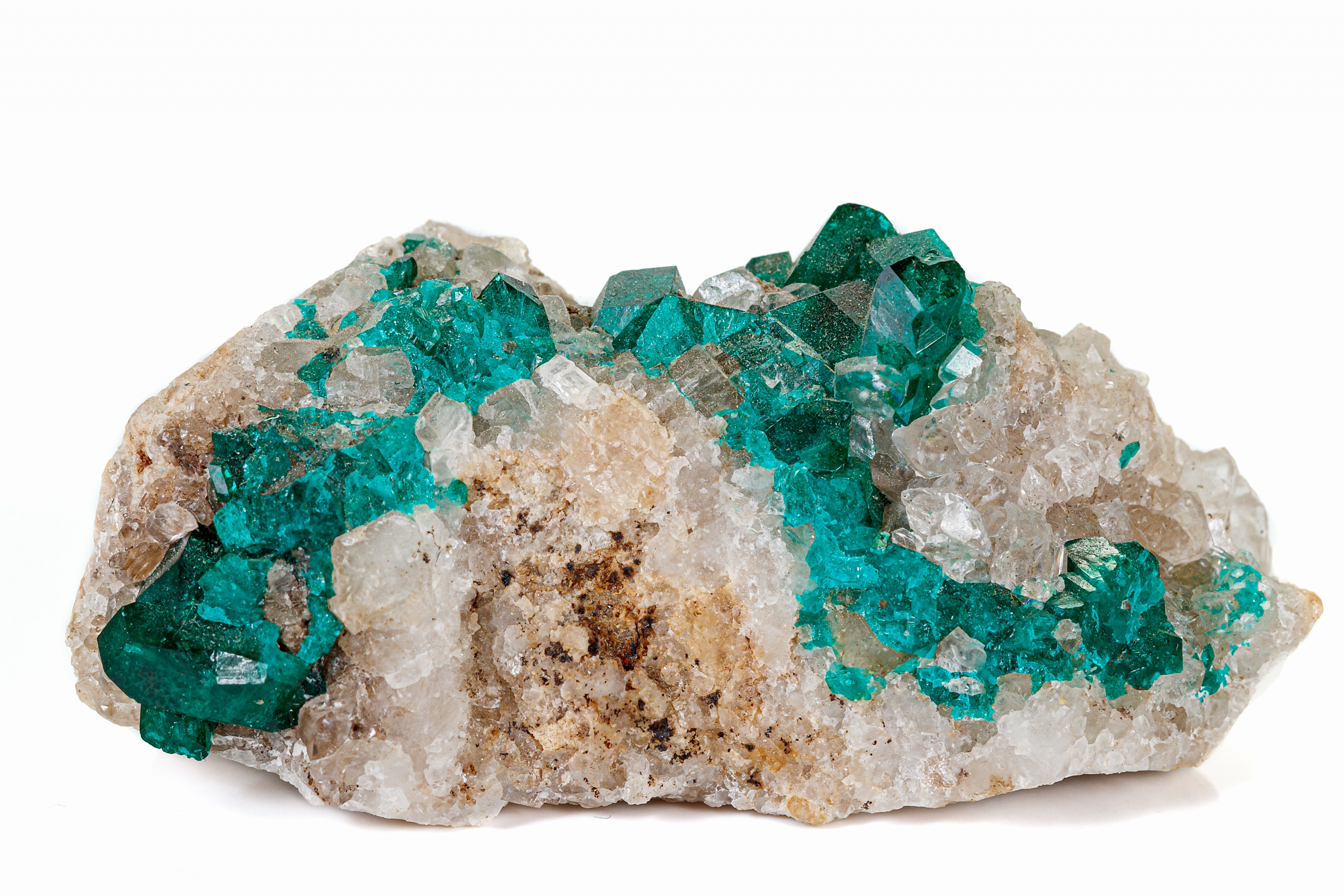

Run a light across a druzy specimen and the whole surface flickers, hundreds of tiny facets catching and throwing back light at slightly different angles. It reads almost like glitter embedded in stone. It isn’t a coating or a treatment, though, it’s a crust of fully formed, individually terminated crystals, just small enough that they cover a surface instead of standing alone.
A crowded nucleation event
Druzy, sometimes spelled drusy, forms when a mineral-rich solution crystallizes across a rock surface fast enough, or with enough nucleation points at once, that instead of one or two crystals growing large, dozens or hundreds of tiny seed crystals start growing simultaneously, shoulder to shoulder, across the same patch of matrix. Each one still grows with its own proper crystal faces and, where quartz is involved, its own sharp termination, they’re just small because they’re competing with their neighbors for the same limited space and mineral supply. This golden Herkimer cluster shows the effect clearly: dozens of small double-terminated points packed into dense druzy texture across one specimen rather than a single large crystal.
It shows up across very different rocks
Quartz is the most common druzy-forming mineral, but the texture itself isn’t unique to any one species, it’s a growth pattern that can happen with several minerals under the right conditions. This warm, smoky-toned quartz cluster and this cluster from Chihuahua, Mexico, with its clear-to-smoky terminated points catching light across the whole matrix, both show the same underlying mechanism producing noticeably different looks, proof that druzy describes a texture, not a fixed color or locality.
Why it’s not the same as a polish
Because druzy crystals are genuinely faceted rather than smoothed, no amount of tumbling or buffing reproduces the effect, and polishing a druzy surface would actually destroy it by grinding down the individual terminations that create the sparkle in the first place. It’s one of the few mineral textures that’s essentially impossible to fake convincingly, which makes it a reasonably safe purchase if you’re worried about treated material. For the Herkimer-specific version of this growth story, including why New York’s Mohawk Valley produces so much of it, see our deep dive on Herkimer diamonds.