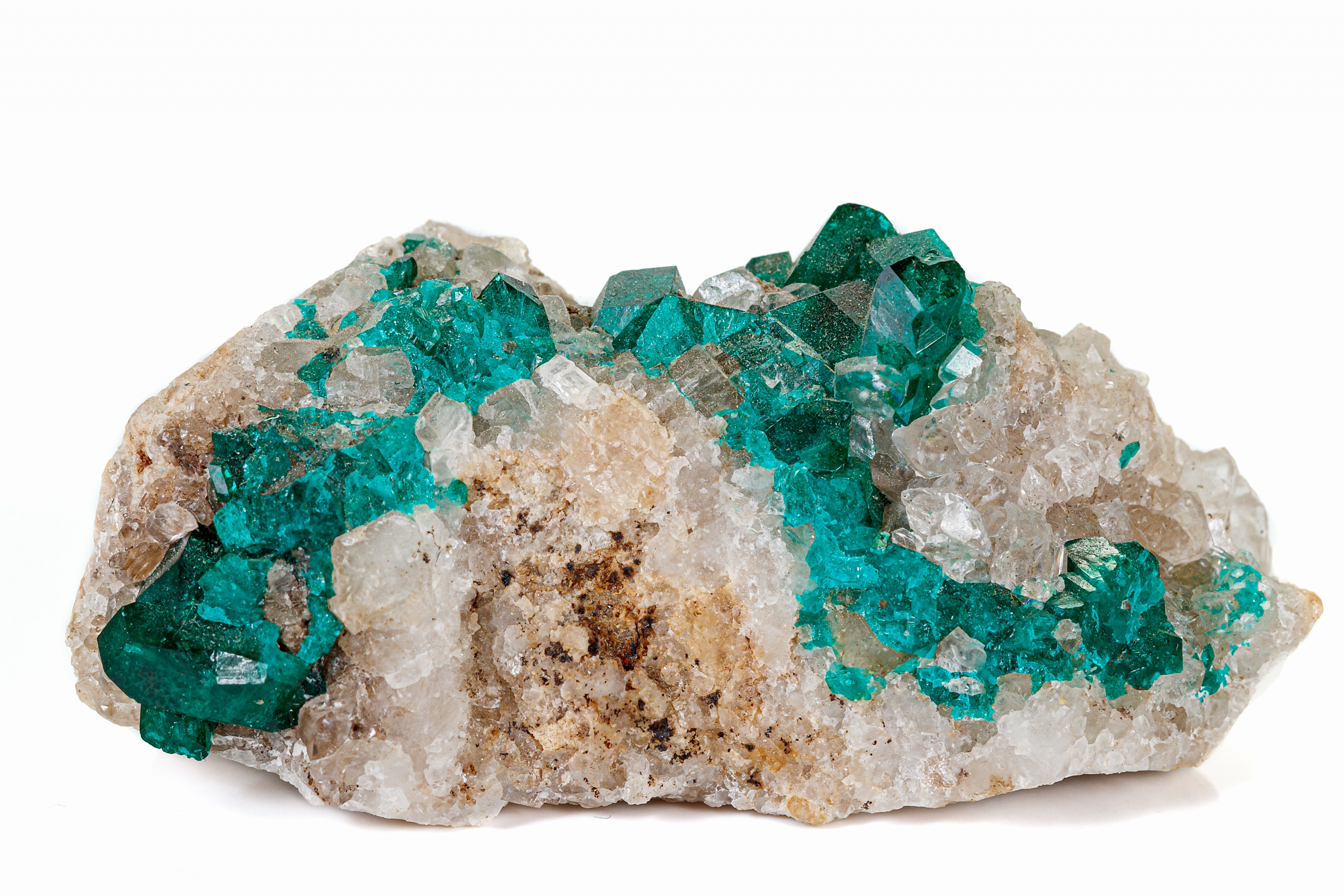

Write out the chemical formula of calcite and the chemical formula of aragonite and you get the same three symbols in the same proportions: CaCO3. They are still two different minerals, with different hardness, different density, different crystal symmetry and different habits. This is polymorphism, and it is the reason a mineral species can never be defined by chemistry alone.
Same atoms, different packing
A mineral is defined by two things: what it is made of, and how those atoms are arranged. Polymorphs share the first and differ in the second. In calcite the calcium and carbonate groups stack in a trigonal arrangement. In aragonite the same units pack orthorhombically, slightly more tightly. That extra density is measurable: calcite sits around 2.71 grams per cubic centimetre, aragonite around 2.93, which is enough of a difference to detect by heft in a large piece.
They also break differently. Calcite has perfect cleavage in three directions and separates into rhombs, as described in calcite’s three famous shapes. Aragonite does not, and tends to form needles, spiky radiating sprays, or the twinned pseudo-hexagonal prisms that trip up beginners.
Which one you get depends on conditions
Calcite is the stable form at ordinary surface temperatures and pressures. Aragonite is metastable, meaning it can exist indefinitely at the surface but is not the lowest-energy option, and it forms preferentially at higher pressures, higher temperatures, or in the presence of magnesium and certain other ions in the water.
Given geological time and a bit of water, aragonite converts to calcite. This is why aragonite fossils are rare in very old rocks and common in young ones, and why a cave formation that started as aragonite may be calcite by the time anyone finds it.
Biology picks a side
This is where it stops being an abstraction. Molluscs build shells out of calcium carbonate, and different groups choose different polymorphs. Nacre, the iridescent inner layer of many shells, is aragonite platelets stacked in sheets. Oyster shell is largely calcite. Coral skeletons are aragonite. Pearls are aragonite.
Organisms are selecting a crystal structure, not just a compound. And because aragonite is more soluble than calcite, marine organisms that build with aragonite are more vulnerable to changes in ocean chemistry than those that build with calcite. A crystallographic distinction turns into an ecological one.
The most famous polymorph pair
Carbon does the same trick more dramatically. Diamond and graphite are both pure carbon, and the gulf between them is the widest in mineralogy: hardest known natural material versus something soft enough to write with. That pair has its own post, same element, opposite extremes.
Quartz has polymorphs too: tridymite, cristobalite, coesite and stishovite are all silicon dioxide, stabilised at different temperatures and pressures. Coesite and stishovite only form at pressures high enough that finding them in surface rock is direct evidence of a meteorite impact.
Not the same as a pseudomorph
Worth separating two ideas that sound alike. A polymorph is a different arrangement of the same chemistry. A pseudomorph is one mineral replacing another while keeping its external shape, which usually involves a change of chemistry too. Aragonite converting to calcite while keeping its outline is, satisfyingly, both at once.
Seeing it on a shelf
Our quartz and calcite specimen from Mexico and the Ohio dogtooth calcite are both calcite, the stable polymorph, which is what you overwhelmingly encounter in collections. If you ever handle a carbonate that is noticeably heavier than it looks and refuses to cleave into rhombs, aragonite is the first thing to suspect.
Two minerals, one formula. It is a good reminder that in mineralogy, arrangement is as much a part of identity as composition, which is exactly why the approval process described in how a new mineral becomes a mineral demands structural data and not just an analysis.