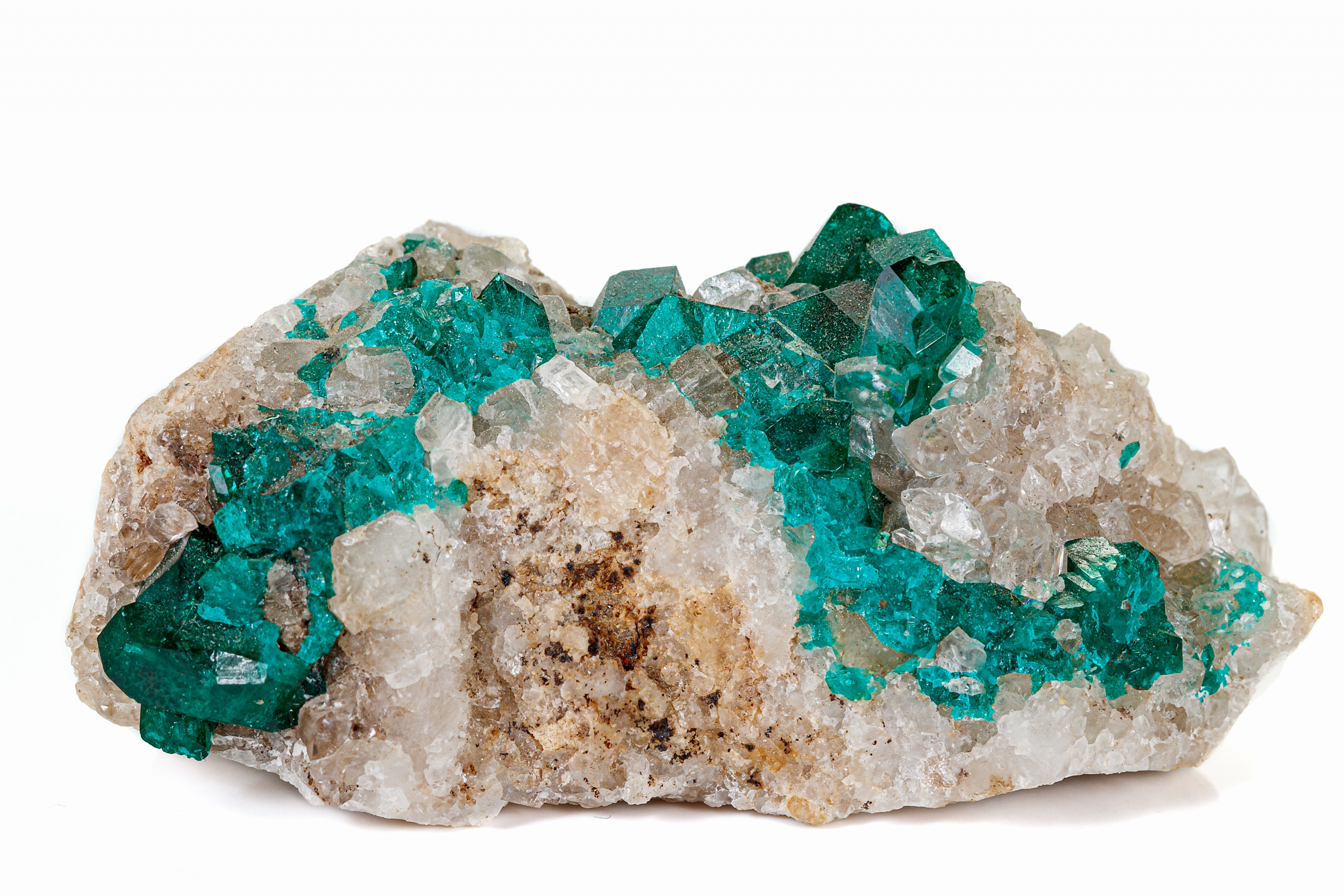

There are roughly 6,000 recognised mineral species on Earth, and about 100 more get added every year. That number is not an estimate or a running tally kept by enthusiasts. It is a formal register, maintained by a committee, with an application process.
The commission
The body in charge is the Commission on New Minerals, Nomenclature and Classification, which sits within the International Mineralogical Association. It was established in 1959, and before it existed, mineral naming was genuinely chaotic. The same material might carry three names in three countries, and plenty of published species turned out on re-examination to be varieties of things already described.
Since 1959, a mineral is not a mineral until the CNMNC votes it through.
What a proposal has to contain
To be approved, a candidate needs to be demonstrably distinct in either its chemistry or its crystal structure, or both, from everything already on the list. In practice a proposal has to include:
- Quantitative chemical analysis, usually by electron microprobe, giving an empirical formula.
- Crystal structure data, normally single-crystal X-ray diffraction, establishing the unit cell and symmetry, one of the seven crystal systems.
- Physical property measurements: hardness, density, optical behaviour, lustre, colour, streak.
- A type locality, precisely stated.
- A type specimen deposited in a recognised public museum, permanently, so that any future researcher can re-examine the actual material. This requirement is the backbone of the whole system.
- A proposed name, with justification.
The proposal goes to the commission, members vote, and approval or rejection follows. Only then can the description be formally published.
The naming rules
Names generally honour a person, record the type locality, or describe a property or composition. Prehnite, for example, was the first mineral ever named after a person, a story told in its own post. Charoite is named for the Chara River in Siberia, its only known source, as covered in charoite.
There are constraints. A name cannot duplicate or closely resemble an existing one. Names honouring people require the person’s consent where possible. And commercially motivated names get a cold reception, which is why so many trade names never become species names.
Species versus variety, and why it matters to a buyer
This is the part with practical consequences. A great many familiar crystal names are not mineral species at all. They are varieties: a named appearance of a species that is already on the list.
Amethyst is not a species. It is purple quartz, and so are our amethyst clusters. Citrine, rose quartz, smoky quartz, milky quartz and the clear quartz point are all the same species, silicon dioxide, differing only in trace impurities and colour centres. Ruby and sapphire are both corundum. Emerald and aquamarine are both beryl. Jade is two entirely different minerals sharing one name.
Tanzanite is the neatest example of the boundary. The species is zoisite, described in 1805. Tanzanite is a trade name coined in 1968 for the blue-violet vanadium-bearing variety from one locality in Tanzania. Mineralogically it is blue zoisite. Commercially it is tanzanite, and the commercial name is the one people pay for.
None of this is dishonest, but knowing the difference makes you a much better reader of labels, which is the theme of rock, mineral or crystal. There are also trade names in circulation with no mineralogical basis whatsoever, invented purely for marketing.
Minerals get un-approved too
The commission also discredits species. If re-examination shows a described mineral is actually a known one, or a mixture, or that the original data were wrong, it is struck from the list. Dozens of nineteenth-century species have gone this way. That is not an embarrassment, it is the system working, and it is only possible because type specimens were preserved, which is the same argument made in provenance and paperwork.
Six thousand species, a hundred new ones a year, and a museum drawer somewhere holding the original of every one of them.