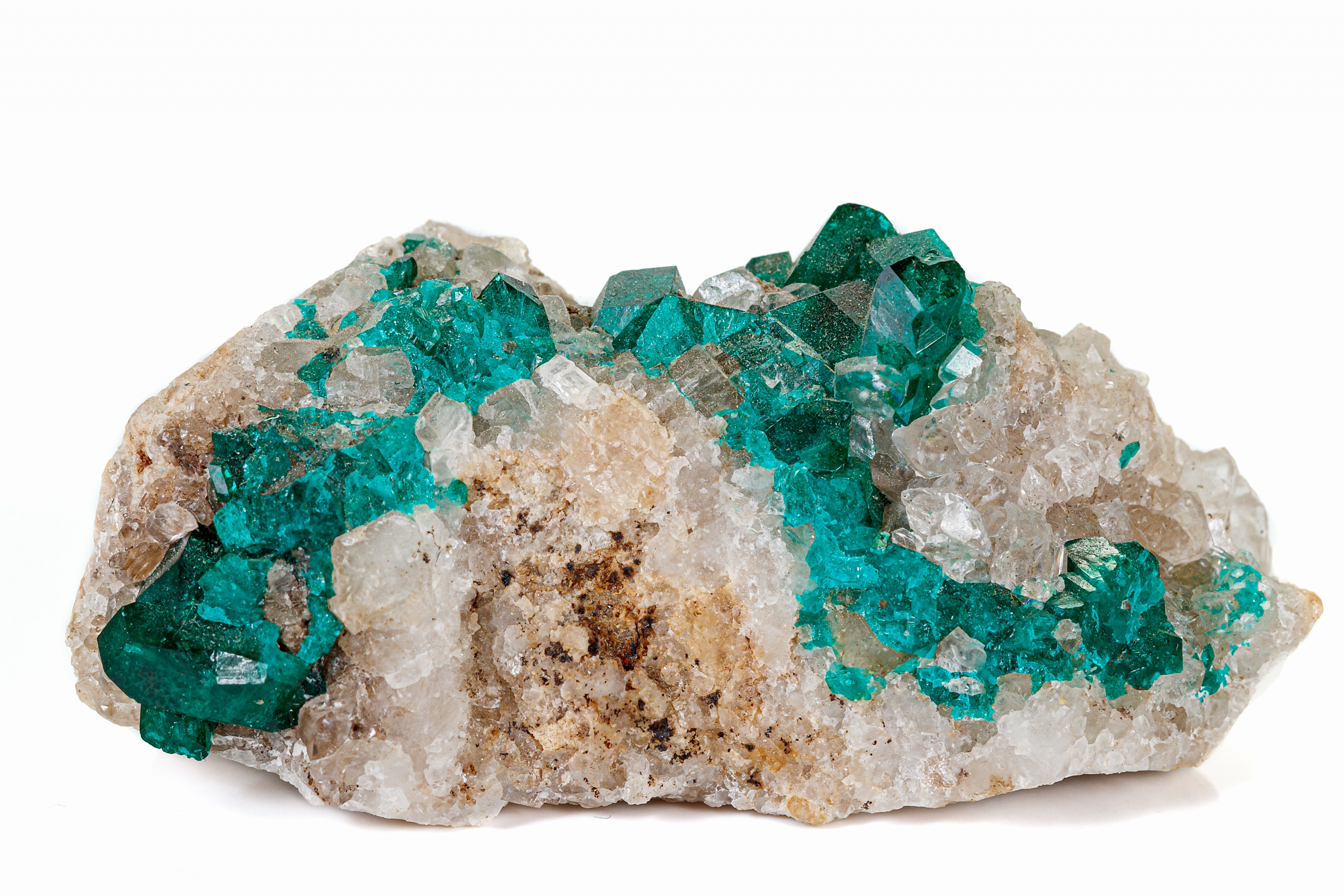

In 1756 the Swedish mineralogist Axel Cronstedt heated an unfamiliar mineral with a blowpipe and watched it froth and bubble as water poured out of it. He called the whole class boiling stones, from the Greek. The mineral was stilbite, and the name he coined, zeolite, has stuck for 270 years.
A mineral with holes in it
Zeolites are framework aluminosilicates, built from linked silicon-oxygen and aluminium-oxygen tetrahedra like feldspars. The difference is that the zeolite framework is open. Instead of a densely packed net, the tetrahedra form a rigid scaffold with channels and cages running through it, wide enough for water molecules and loosely held cations to sit inside.
Crucially, those guests can leave and return without collapsing the structure. Heat a zeolite and the water walks out. Cool it in a damp room and the water walks back in. That reversibility is the defining property of the whole group and the reason Cronstedt’s stilbite frothed instead of simply breaking down.
Where collectors find them
Zeolites form where hot, alkaline, silica-rich water circulates through volcanic rock, most famously through the gas cavities in basalt flows. A cooling lava flow traps bubbles. Later, groundwater moves through, and those cavities become mineral growth chambers, a process laid out in basalt’s hidden cavities and in geodes, nodules and vugs.
The classic American locality for this is the New Jersey trap rock belt, where three stacked Jurassic lava flows have been quarried for two centuries. That geology is the subject of both the Watchung Mountains and Paterson quarries posts.
Stilbite is the signature New Jersey zeolite, growing in the wheat-sheaf or bowtie habit that makes it instantly recognisable. We carry it as a nine-piece bowtie lot and a smaller four-piece lot, and the mineral gets its own treatment in stilbite, the bowtie crystal. Our fourteen-piece New Jersey and New York lot is drawn from the same regional geology.
Worth noting: prehnite, which keeps the same company in those cavities, is not actually a zeolite. It is a close associate that gets filed with them out of habit.
The industrial second life
Here is where a collector mineral turns into infrastructure. Because zeolite channels have a fixed, precise diameter, they sort molecules by size. Anything small enough passes through, anything larger does not. They are, literally, molecular sieves.
Synthetic zeolites, manufactured to specification rather than mined, now do an extraordinary amount of work:
- Oil refining. Zeolite catalysts run fluid catalytic cracking, the process that breaks heavy petroleum fractions into petrol. This is the single largest use of catalysts by volume on Earth.
- Oxygen concentrators. Medical and industrial oxygen units use zeolite beds to preferentially adsorb nitrogen out of air, leaving concentrated oxygen. The machine in a hospital room is running on a mineral principle.
- Water softening and detergents. Zeolites swap their loosely held sodium for the calcium and magnesium that cause hard water.
- Cat litter and absorbents. The open framework holds moisture and traps ammonia.
- Nuclear cleanup. Zeolites will preferentially capture caesium and strontium ions from contaminated water, and have been deployed at more than one reactor site for exactly that.
Handling them
Zeolites are soft, typically Mohs 3.5 to 5.5, and many are delicate sprays that will not survive being knocked. They also lose and regain water, which means aggressive drying, a hot car, or a sunny windowsill can dehydrate a specimen and turn a glassy crystal chalky. Keep them cool, out of direct sun, and out of ultrasonic cleaners. The general advice in cleaning and storing specimens applies, with the heat warning doubled.
A mineral defined by what it does not contain is an odd thing to collect. It is also, from an industrial standpoint, one of the most valuable structural ideas in chemistry.