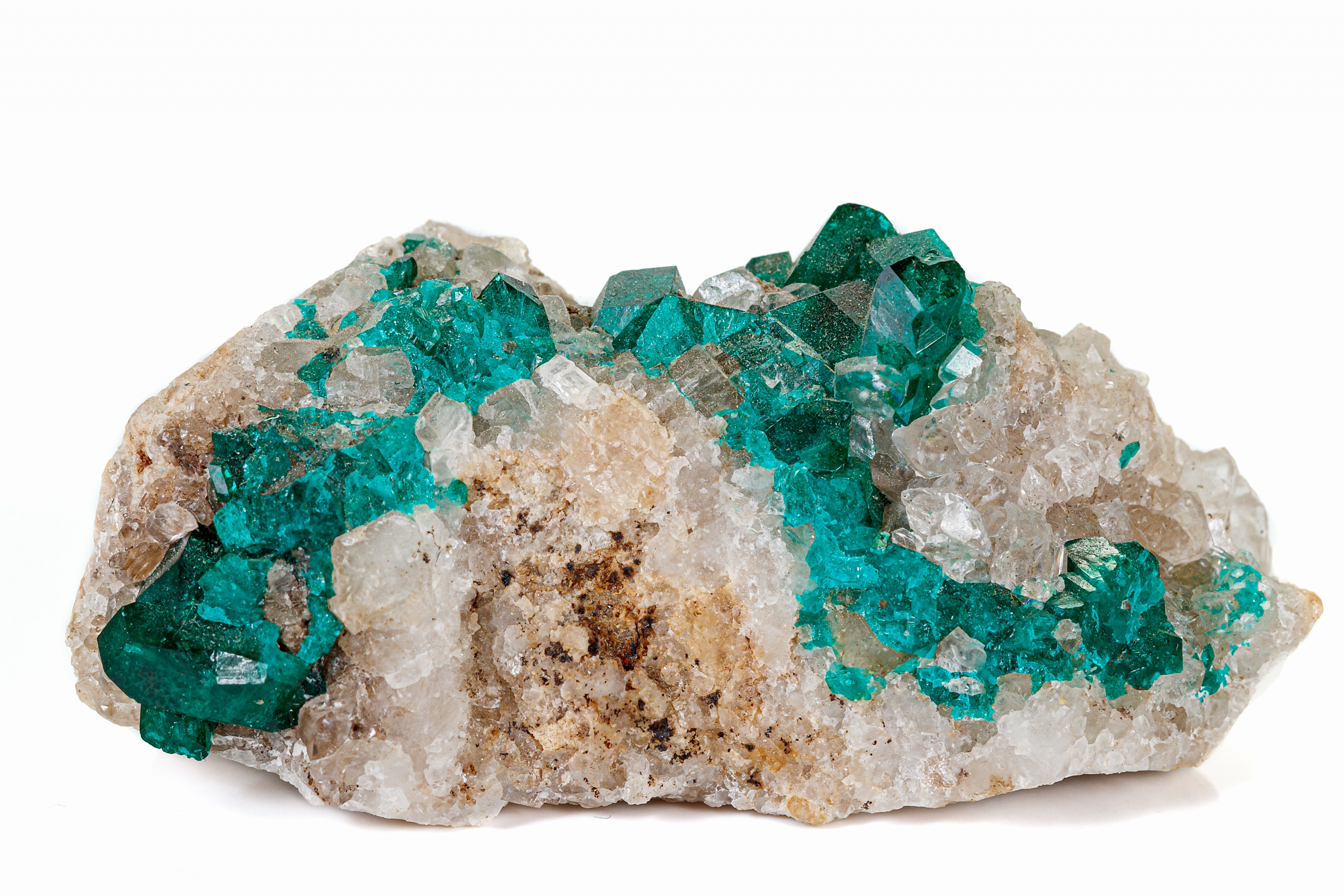

Slice a piece of malachite and the cut face usually reveals concentric bands, light and dark green rings wrapping around each other like a cross-section of a tree, except nothing about malachite grows the way a tree does. Those bands are a genuine growth record, just recorded through chemistry rather than seasons.
Built the same way, one thin layer at a time
Malachite, a copper carbonate hydroxide, typically forms the same way azurite slowly converts into it: copper-bearing groundwater reacting with carbonate rock near the surface, depositing thin botryoidal crusts, rounded, grape-like clusters of microscopic fibrous crystals, one layer at a time as fluid chemistry shifts slightly with each pulse of mineral-rich water. Each band marks a change in the exact concentration of copper and carbonate ions available at that moment, the same underlying principle behind why phantom quartz records pauses in its own growth, just visible here as color variation instead of a ghostly internal outline.
Reading the pattern
Tighter, more numerous bands generally indicate a slower, more consistent flow of mineral-rich water over a longer period, while broader, more irregular bands suggest faster, less stable deposition. It’s not a precise dating method the way tree rings can be, malachite doesn’t grow on an annual cycle, but the pattern still functions as a rough record of how stable the groundwater chemistry around a deposit was while the specimen formed.
The eye-catching part, the deep green banding itself, is really just the visible signature of an ordinary and fairly common mineral-forming process, repeated slowly enough and consistently enough to leave a pattern worth cutting and polishing.