
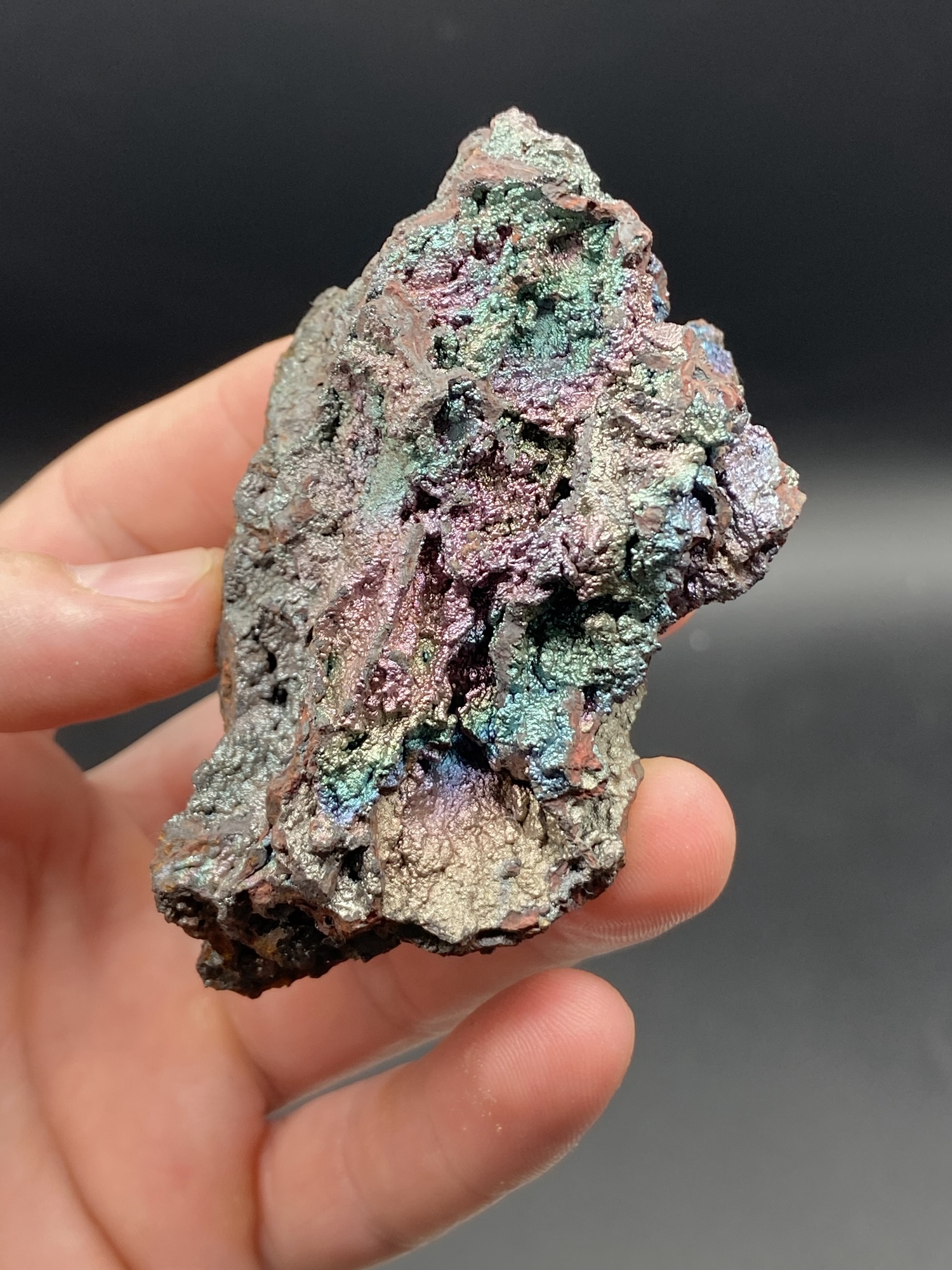
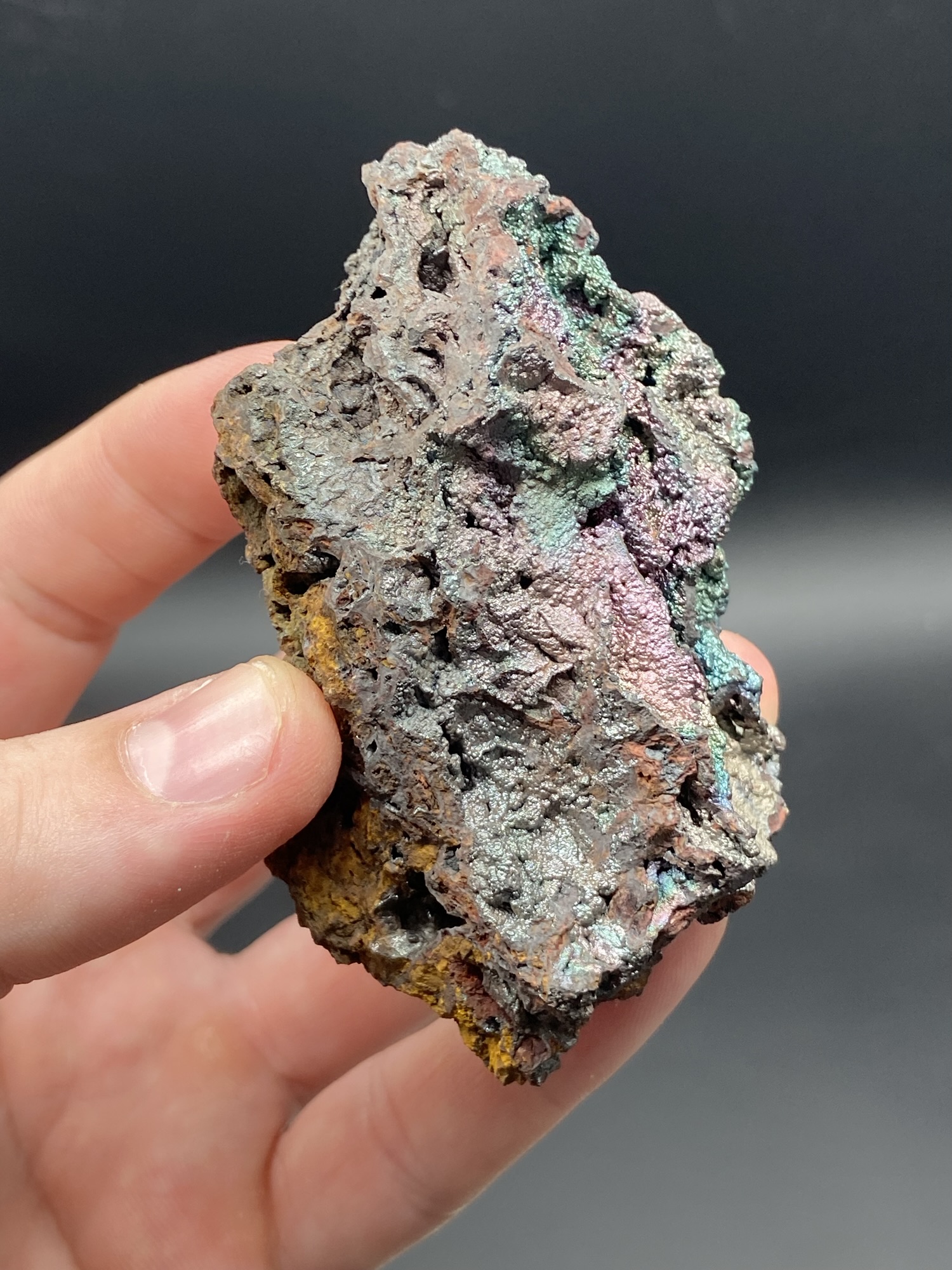
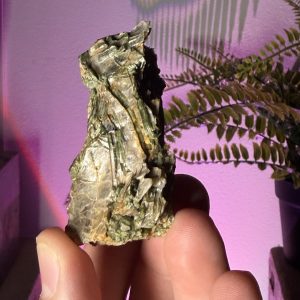
Graves Mountain in Lincoln County, Georgia is one of the world’s best-known localities for iridescent hematite, sometimes called “rainbow” or “peacock” hematite. The iridescence isn’t a coating or treatment — it comes from an ultra-thin natural oxidation layer on the hematite’s surface that splits light the same way a thin film of oil does on water, producing shifting colors across the metallic gray surface as the angle of light changes.
Hematite is an iron oxide (Fe₂O₃) at Mohs hardness 5–6, and this piece also shows patches of goethite, an iron oxyhydroxide (FeO(OH)) with a slightly softer, more textured, almost bubbly surface that often forms alongside hematite at the same localities. Seeing both minerals together on one specimen is typical of Graves Mountain material and adds visual depth beyond the iridescence alone.
This is the exact piece pictured, with its rainbow sheen and goethite texture catching the light beautifully from multiple angles — a standout for hematite and Georgia locality collectors, and a strong display piece on its own.
Inside Hematite & Goethite
The rainbow sheen here is the same physics as an oil slick — not dye, not coating.
The story: Both minerals are weathering products of iron-bearing rock, and both were major players in the Great Oxidation Event roughly 2.4 billion years ago, when Earth’s oceans first filled with free oxygen and dissolved iron began rusting out of solution on a planetary scale. Where hematite and goethite grow intergrown in thin layers, they can produce the iridescent, rainbow-sheened surface seen on pieces like this one — a thin-film interference effect, the same optics as an oil slick on water.
Why collectors chase it: That metallic rainbow iridescence makes these among the most photogenic specimens in any mineral collection.
Care: Durable, but a real streak test (rubbing on unglazed porcelain) leaves a permanent red-brown mark — don’t test it on your own display tile.
Reviews
There are no reviews yet.