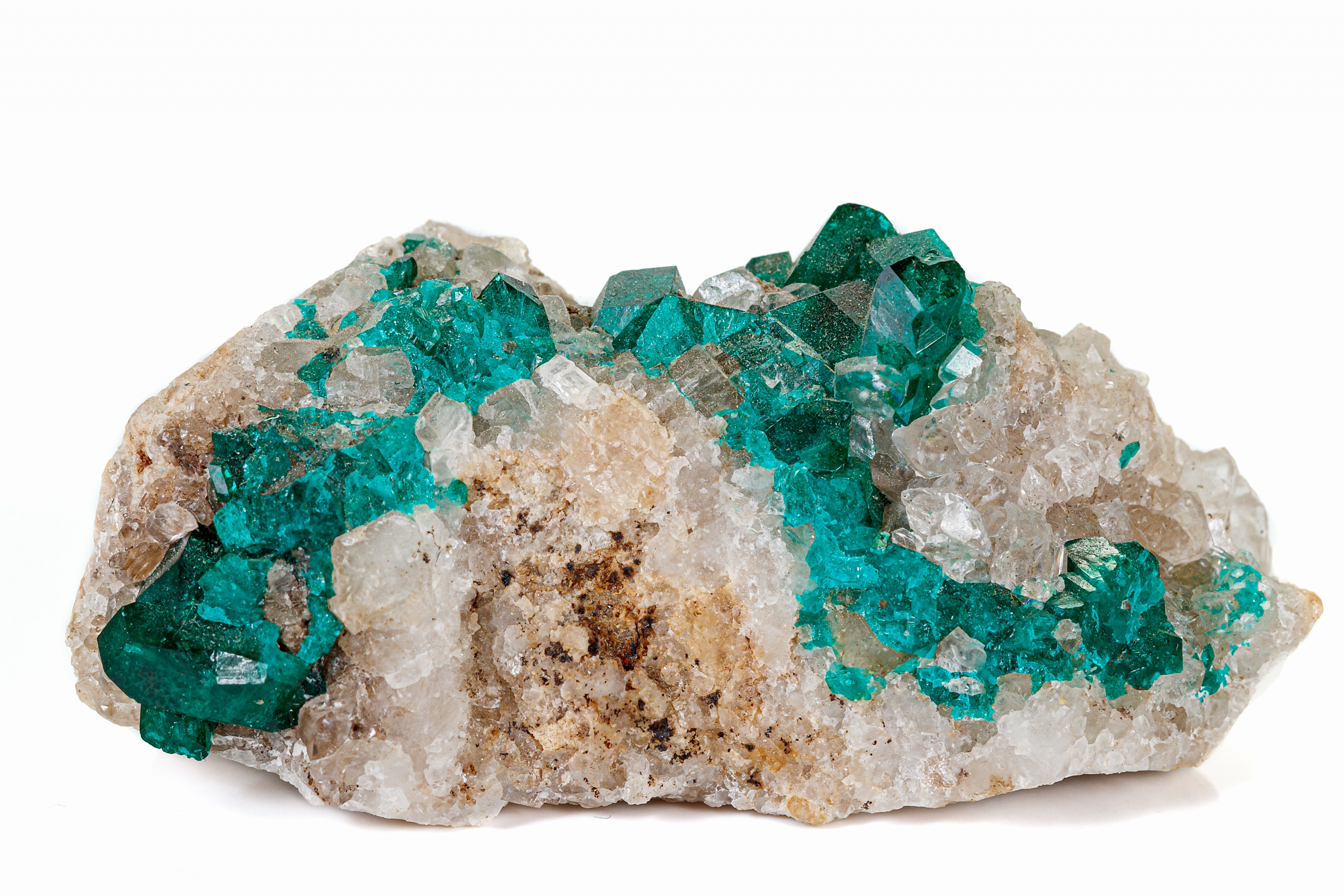

Tourmaline is the mineral group that chemists complain about. Its formula is so accommodating that early mineralogists joked it read more like an apothecary’s prescription than a respectable chemical compound. That flexibility is exactly why tourmaline comes in more colours than any other mineral group, and why the most common member of it is plain black.
Not one mineral
Tourmaline is a group of borosilicates, currently well over thirty approved species. Elbaite is the gem one: pink, green, watermelon. Dravite is the magnesium-rich brown one. Schorl is the iron-rich black one, and schorl alone accounts for the overwhelming majority of all tourmaline on Earth.
The structural trick is that tourmaline has several different sites in its lattice that will accept a wide range of ions, so aluminium, iron, magnesium, lithium, sodium, calcium and more can slot in without breaking the framework. Whatever is left over in the fluid gets taken up. Fill the iron sites and you get schorl.
Boron is the whole story
Every tourmaline needs boron, and boron is not common in ordinary rock. It is incompatible, meaning it does not fit comfortably into the crystal structures of the minerals that crystallise first from a melt. So as a granite body cools and crystallises, boron is progressively concentrated into the last remaining fluid, along with lithium, fluorine and water.
That leftover fluid is where pegmatites form. It is also where tourmaline forms. Finding schorl in a rock is a direct statement about the chemistry of the last few percent of a magma body, which is a remarkable amount of information to get from a black crystal.
Why it grows with mica
Mica likes the same conditions for the same reason. Muscovite and lepidolite are hydrous, they accept aluminium and, in lepidolite’s case, lithium, and they crystallise late from the same boron- and water-rich residual fluid. Schorl and mica are not neighbours by coincidence, they are two products of the same leftover.
Our golden mica with tourmaline and the larger chunky golden mica with tourmaline both show that association, as does the mica with tourmaline inclusions. The dark prisms threading through the sheets are the tail end of a granite’s chemical life. There is more on that kind of pairing in two minerals, one stone, and more on mica itself in mica’s industrial life and lepidolite.
The triangular cross-section
Schorl is easy to recognise once you know what to look for. It grows as elongated prisms, heavily striated along their length, and the cross-section is a rounded triangle rather than a hexagon. That triangular outline comes from the trigonal symmetry of the structure and is one of the most reliable field identifications in mineralogy. Hardness is 7 to 7.5, so it will scratch glass comfortably.
The striations are not damage. They are the edges of repeatedly stacked narrow crystal faces, a growth feature discussed more generally in crystal habit.
The ash puller
Tourmaline is pyroelectric and piezoelectric. Heat it and the two ends of the crystal develop opposite electrical charges. Squeeze it and the same thing happens.
This was noticed long before anyone understood it. Dutch traders in the early eighteenth century brought tourmaline back from Sri Lanka and found that a warmed crystal would attract ash and small particles out of a fireplace, which earned it a Dutch nickname meaning, roughly, ash-puller. It was a parlour curiosity for a century before the Curie brothers formalised piezoelectricity in 1880 and gave the effect a physics. The same property in quartz is what ended up in your watch, as explained in piezoelectricity.
Why black tourmaline gets no respect
Gem tourmaline is expensive because elbaite in clean colour is rare. Schorl is neither rare nor transparent, so it has never carried a gem price. But it is the tourmaline that tells you the most about where you are standing. A granite with schorl in it had a boron-rich final fluid. A granite without it did not. The common mineral is usually the more informative one.