
Herkimer diamonds all come from a strikingly narrow band of rock in central New York’s Mohawk Valley, and the reason isn’t luck or a particularly rich mining district, it’s one specific rock formation that happens to have exactly the right cavities in exactly the right chemistry.
The Little Falls Dolostone
The quartz crystals known as Herkimer diamonds grow almost exclusively within vugs, gas or fluid cavities, inside the Little Falls Dolostone, a roughly 500-million-year-old Cambrian-age rock formed originally as marine sediment before being converted to dolostone. Those vugs provided open, mineral-rich, undisturbed pockets where silica-saturated groundwater could deposit quartz slowly over an enormous stretch of geologic time, exactly the conditions needed for well-formed, doubly-terminated crystals rather than the more typical single-ended points anchored to matrix, the reason our general Herkimer piece covers separately.
A narrow formation, a narrow district
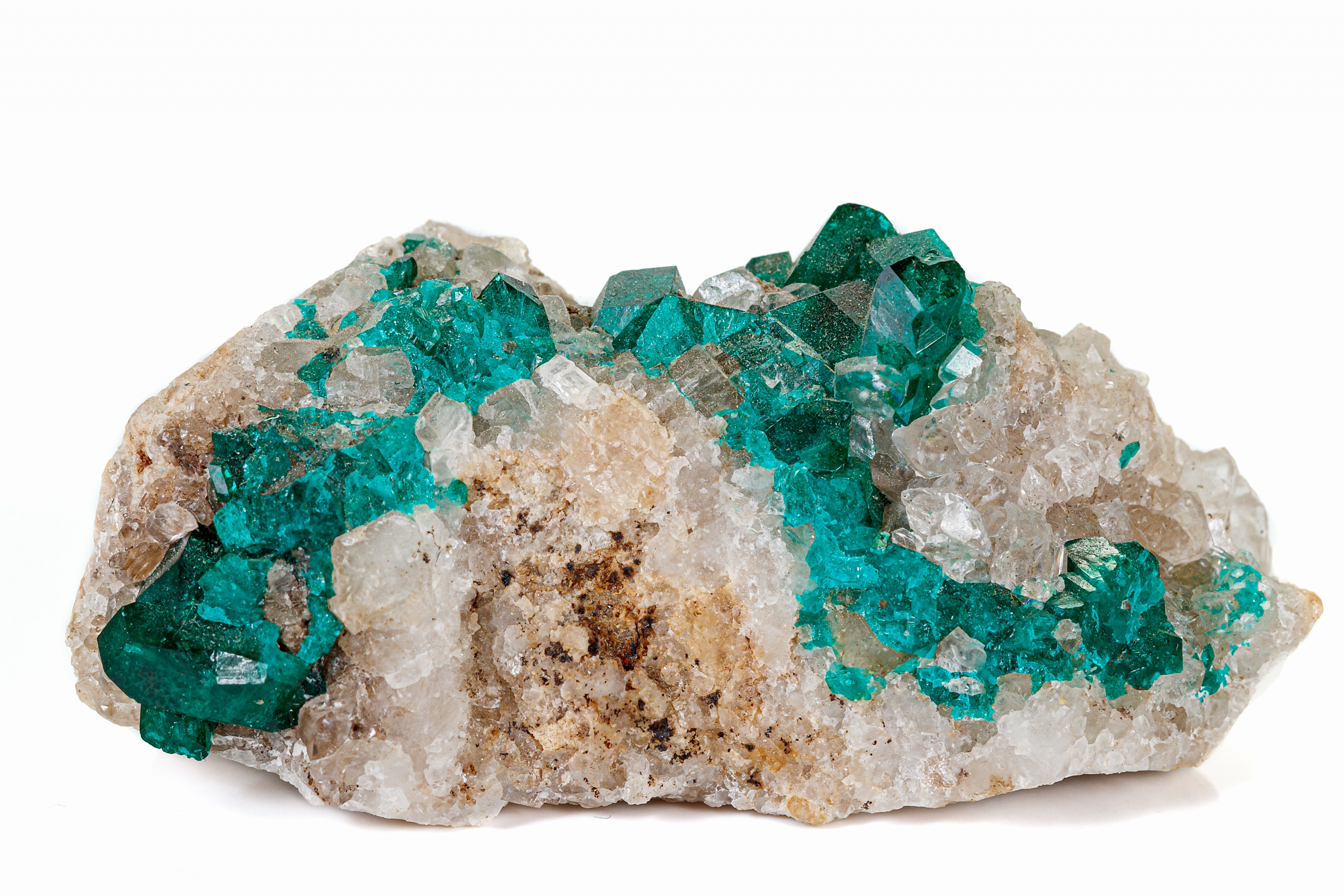
Because the Little Falls Dolostone only outcrops in a limited band across Herkimer and neighboring counties, genuine Herkimer diamonds are geographically constrained in a way most quartz varieties aren’t, quartz points from elsewhere in New York or New England don’t carry the name regardless of how similar they look, since the term specifically refers to material from this one formation. This cluster, recovered directly from the Mohawk Valley district, is the genuine article for exactly that reason.
It’s a good example of how a locality name can function almost like a formation name in geology, “Herkimer diamond” isn’t really describing a variety of quartz so much as identifying quartz that grew in one very specific, well-documented layer of ancient dolostone.