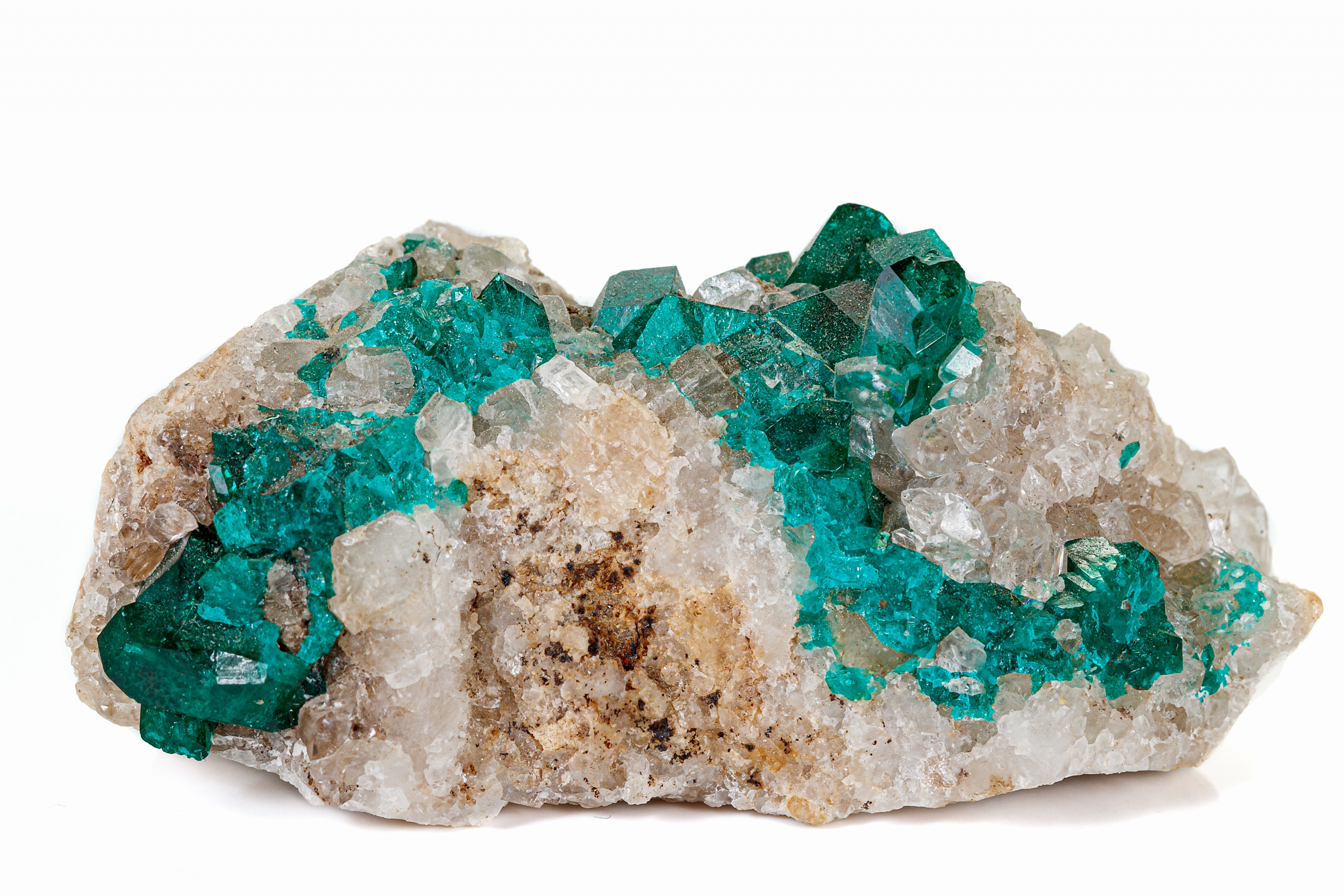

Every crystalline mineral on Earth, thousands of species, organizes into just seven basic geometric families, called crystal systems. It’s one of the more useful facts in mineralogy precisely because it’s a shortcut: learn the seven shapes and you’ve learned the underlying logic behind almost every crystal habit you’ll ever see.
Symmetry, not size or color
A crystal system is defined by symmetry, specifically by how many axes of a certain length meet at what angles within a mineral’s repeating atomic structure, not by how a specimen happens to look on a shelf. The seven systems are cubic (also called isometric), tetragonal, orthorhombic, hexagonal, trigonal, monoclinic, and triclinic, ranging from cubic’s high symmetry, three equal axes all meeting at right angles, down to triclinic’s minimal symmetry, three unequal axes meeting at three different oblique angles. Galena’s cubes and pyrite’s cubes both belong to the cubic system for exactly this reason, despite being chemically unrelated minerals.
Why quartz points aren’t cubes
Quartz crystallizes in the trigonal system, built around a single threefold axis of symmetry, which is why quartz points grow as six-sided prisms capped with pointed terminations rather than anything resembling a cube. The same trigonal symmetry shows up in calcite, explaining why both minerals, chemically unrelated, share a family resemblance in their more elongated, pointed habits. Our piece on crystal habit covers how growth conditions vary a mineral’s final shape, while the crystal system sets the underlying geometric rules that habit has to work within.
A mineral can never violate its own crystal system’s symmetry no matter how it grows, crowded, druzy, or as a single large point, it’s the one property of a crystal’s shape that growth conditions can’t override.