
Ask a collector to name a great quartz locality and you’ll usually hear Arkansas, Brazil, or the Alps. Chihuahua, Mexico’s largest state by land area and a major hub of Mexican mining going back centuries, rarely comes up, despite producing some of the more consistently well-formed druzy quartz clusters on the market.
Desert geology built for clean crystals
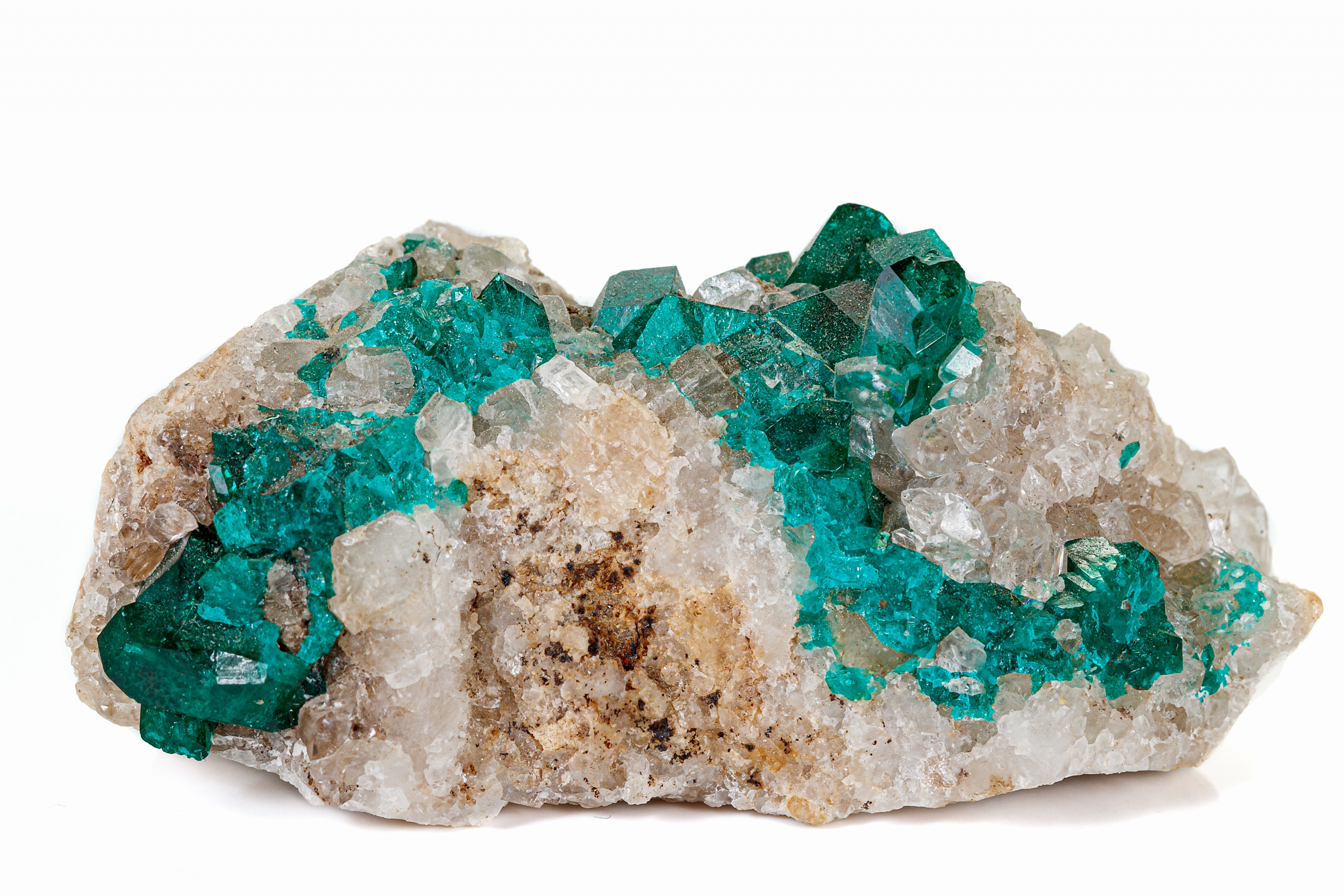
Chihuahua sits within Mexico’s Basin and Range province, the same broad geologic setting that stretches north into Arizona and Nevada, defined by fault-bounded mountain ranges rising out of flat desert basins. That faulting opens cavities and fracture systems in the surrounding rock, and low humidity across the region means less chemical weathering disturbs the minerals once they’ve formed, a combination that tends to favor clean, well-preserved quartz over the more weathered or clay-coated crystals common in wetter climates. This cluster, dozens of clear-to-smoky terminated points catching light across the matrix, is a fairly typical result of that environment.
A mining region long before crystals were the point
The state’s mining history goes back to Spanish colonial silver operations in the 1600s and 1700s, and it remains one of Mexico’s most heavily mined regions for silver, lead, zinc, and copper today. Quartz specimens are largely a byproduct of that industrial-scale mining rather than the primary target, crystals get exposed and recovered while extracting the metals the mines actually exist for, which is a very different origin story than a locality mined specifically for crystal specimens.
How it compares to the Northeast material we usually cover
Most of the U.S. quartz in this shop, the New York, New Jersey, and New Hampshire material, formed in glacially scoured igneous and metamorphic rock in a temperate climate with very different weathering conditions, which is one reason that material often carries more surface frosting or iron staining than pieces from an arid region like Chihuahua. Our Northeast rockhounding guide covers that regional geology in more depth, and it’s worth the comparison: same mineral, same basic growth chemistry, genuinely different result depending on where in the world it happened.