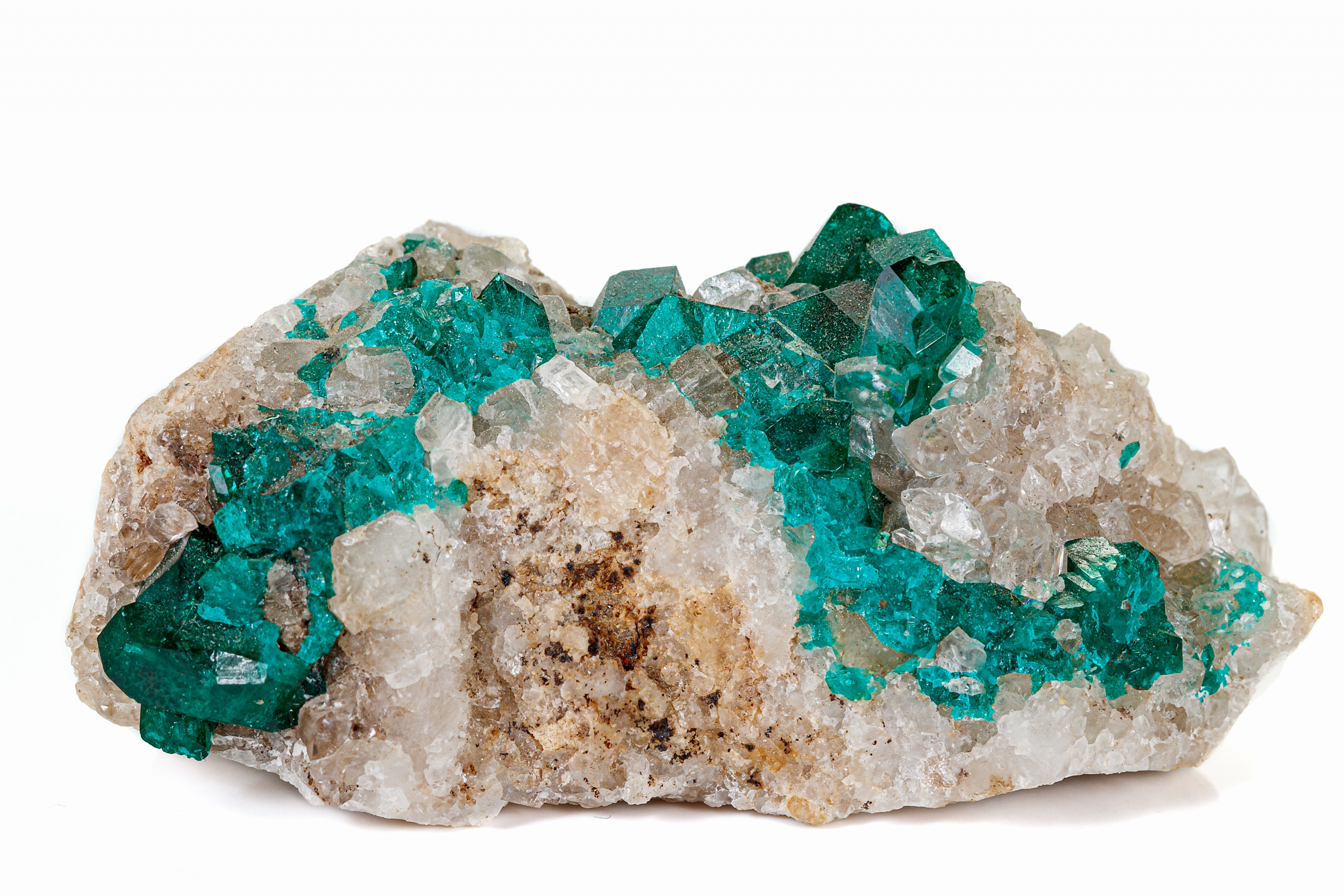

Quartz has picked up a lot of claims about the kind of energy it supposedly holds. It also has one genuinely well-documented electrical property, discovered in a lab in 1880 and now sitting inside a few billion clocks, phones, and radios: squeeze a quartz crystal in the right direction and it generates a small electric voltage across its faces. Run the process backward, apply voltage, and the crystal physically flexes. That’s piezoelectricity, and it’s real, measurable, and the entire reason “quartz” became a synonym for cheap, accurate timekeeping.
Why quartz specifically
The effect comes down to quartz’s crystal structure. Silicon and oxygen atoms arrange themselves in a repeating pattern that lacks a center of symmetry, meaning the atomic structure looks different in one direction than in the reverse direction. Squeeze a crystal like that along the right axis and the atoms shift just enough to separate positive and negative charge onto opposite faces, generating a tiny voltage. Materials with a symmetric atomic structure, most metals included, can’t do this at all, no matter how hard you compress them. It’s a direct consequence of quartz’s particular atomic geometry, not something present in “crystals” generally.
From lab curiosity to every wristwatch
The practical breakthrough came from the flip side of the effect: a quartz crystal cut to a precise shape and driven electrically will vibrate at an extremely stable, predictable frequency, tens of thousands of times per second, largely unaffected by the temperature swings that throw off mechanical clock movements. Count those vibrations electronically and you have a far more accurate timekeeper than a spring and gear train ever managed, which is why “quartz movement” replaced mechanical movements in the vast majority of watches and clocks starting in the 1970s. The same effect, at different scales, shows up in radio frequency filters, sonar transducers, and the ignition sparker on a gas grill.
A useful contrast to keep in mind
A clean, well-formed clear quartz point is exactly the kind of material this property was originally studied in, though commercial watch crystals today are lab-grown to precise specifications rather than cut from natural points. Piezoelectricity is worth keeping in mind next to some of quartz’s other, far less testable reputation, real electrical output, generated on demand and measured in volts, is a different category of claim than most of what gets said about crystal energy. We go through that broader gap between documented mineral science and marketing language in our piece on what the geology actually says about quartz as a “master healer.”