
Walk into any crystal shop and you’ll see clear quartz labeled the “Master Healer,” supposedly capable of amplifying the energy of every other stone around it. That’s a metaphysical claim, not a geological one, and we won’t pretend otherwise. But set the marketing language aside and quartz turns out to have a genuinely remarkable, well-documented physical property, one that has nothing to do with energy amplification and everything to do with electricity.
The Most Common Mineral You’ll Ever Hold
Quartz, silicon dioxide, is the second most abundant mineral in Earth’s continental crust, after feldspar. It shows up in granite, sandstone, veins, geodes, and beach sand alike, which is exactly why it’s one of the most affordable crystals in any shop, ours included. Abundance isn’t a knock against it; it just means the interesting part isn’t rarity.
The One Superpower That’s Actually Measurable
Squeeze or flex a quartz crystal and it generates a small electric voltage across its faces. Run current through it instead, and it vibrates at an extremely precise, stable frequency. That’s the piezoelectric effect, first documented by the Curie brothers in 1880, and it’s real, repeatable, and used constantly: it’s the reason quartz oscillators keep time in wristwatches, computers, and radios far more accurately than a mechanical pendulum ever could. If clear quartz has a superpower, this is the one a lab can verify.
What “Master Healer” Actually Means to a Geologist
There’s no physical mechanism by which a mineral influences health or emotion, and no controlled study has shown one. That doesn’t make owning or displaying quartz pointless; plenty of people simply like having it around, the same way people keep any object with meaning to them. We’d rather tell you plainly what’s demonstrated and what isn’t than dress up the marketing copy.
What to Actually Look For When Buying a Cluster
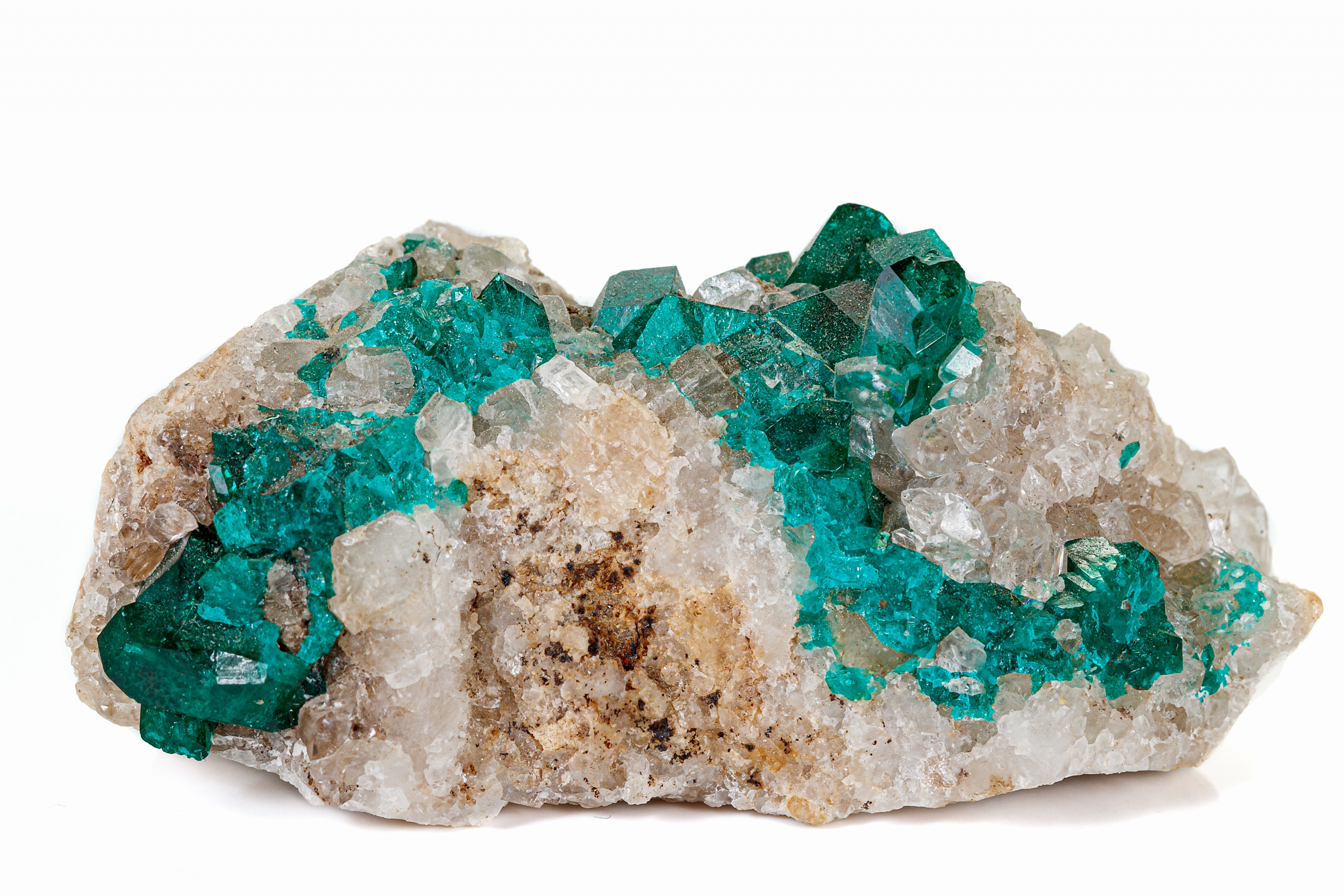
Once you’re picking a piece on its own merits, a few things matter more than the sales pitch: how intact the terminations (the pointed tips) are, since a chipped point is a common and visible flaw; how dense the crystal growth is across the matrix, sometimes called druzy when it’s a fine, sparkling coating of small points; and clarity, though a milky or smoky-tan tint is completely natural, not a defect, and often adds character rather than taking away from it.
Our current clear quartz pieces show that range well. The druzy matrix specimen has warm, smoky-tan coloring across a dense field of small points, while the Chihuahua, Mexico cluster shows dozens of clear-to-smoky terminated points catching light across the matrix. For a single dramatic piece rather than a cluster, we also carry two large individual points, one and another, each with a well-formed termination and enough size to stand on its own. For more on separating natural coloring from anything artificial, see our guide to spotting dyed, heated, or coated crystals, and for basic terminology, rock, mineral, or crystal, what the words actually mean.