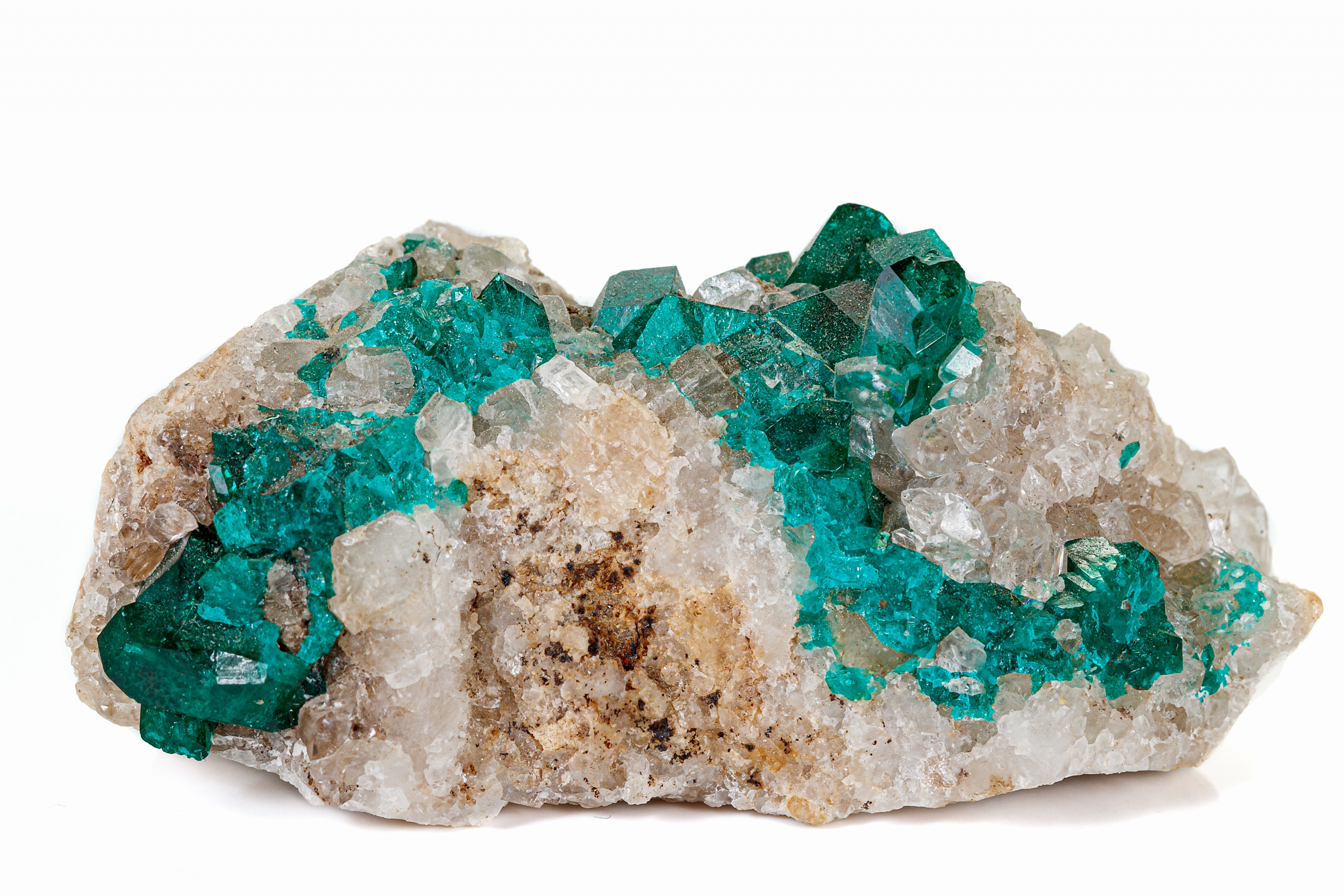

Set a clear rhombohedron of calcite over a printed line of text and, instead of one line, you’ll see two, slightly offset, both perfectly legible. It’s not a trick or a flaw in the crystal, it’s a genuine optical property called birefringence, and calcite shows it more dramatically than almost any other common mineral.
Splitting light in two
Birefringence, or double refraction, happens in minerals whose crystal structure isn’t the same in every direction, which bends light differently depending on which direction it travels through and how it’s polarized. A single ray of light entering a birefringent crystal splits into two separate rays, each traveling at a slightly different speed and bending at a slightly different angle, which is what produces the doubled image. Crystal system plays the deciding role here, minerals in the cubic system, with identical symmetry in every direction, show no birefringence at all, while calcite’s trigonal structure produces some of the strongest birefringence of any common mineral.
Why it matters beyond the party trick
Geologists use birefringence constantly, thin slices of rock examined under a polarizing microscope reveal different minerals lighting up in different interference colors depending on their birefringence, often the fastest way to identify every mineral in a rock sample at once. Our Northeast rockhounding guide touches on how much geologic history gets read directly out of rock rather than guessed at, and birefringence is one of the more precise tools for doing exactly that, distinguishing minerals that might otherwise look identical to the naked eye.
Clear calcite specimens strong enough to show the effect clearly are sometimes labeled “Iceland spar,” a nod to the historically famous Icelandic locality that supplied much of the calcite early optical scientists used to first work out how the effect functioned.