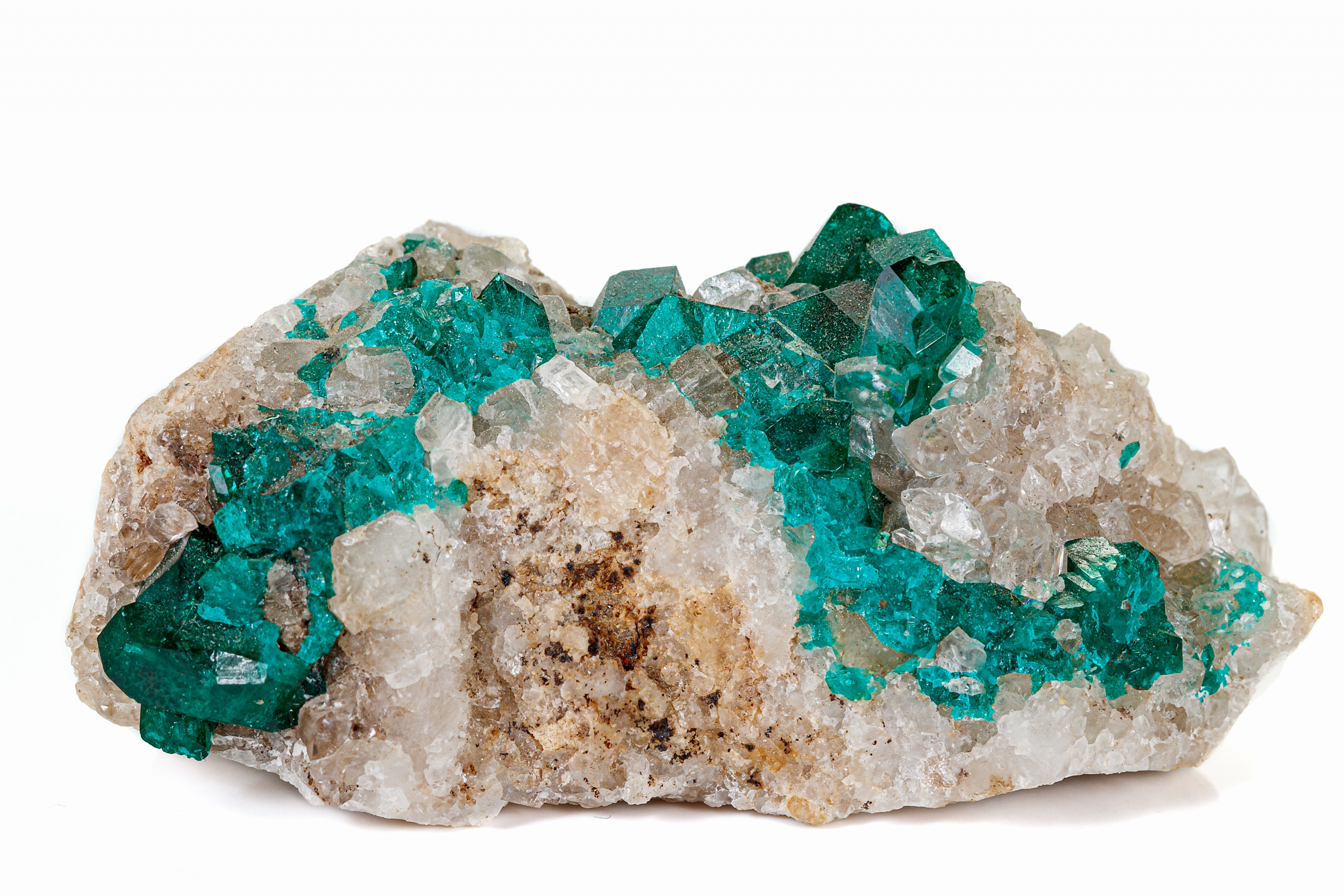

There is no official register of gem-quality minerals. No commission rules on it, no standard defines it, and the same mineral can be gem quality in one crystal and worthless in the next one out of the same pocket. It is a market judgement, and it rests on four things.
One: transparency and clarity
For faceted stones this is the first filter and it eliminates most material immediately. A gem has to transmit light cleanly enough that the cut can do its work, because a facet pattern is an optical device for bouncing light back at the viewer. Fill the interior with inclusions, fractures or cloudiness and the machine stops working.
Most crystals of most gem species are not transparent. Our clear quartz point is a good calibration piece: genuinely clear quartz is common as a species and still uncommon as clean material in any given pocket.
Cabochon material is judged differently, which is why opal, turquoise and moonstone all qualify as gems while failing a transparency test. There, the value sits in an optical effect, not in clarity, as covered in how a cabochon is cut.
Two: colour, and specifically saturation
Hue matters less than saturation and tone. A pale, washed-out stone of the right hue is worth a fraction of a richly saturated one, and an overly dark stone that reads as near-black loses value too. This is why trade descriptions obsess over things like whether a blue is violetish or greenish.
Colour in almost every case comes from trace elements or from structural colour centres, not from the main chemistry of the mineral, which is the subject of trace elements. Our tanzanite rough lot is a useful example: tanzanite’s blue-violet comes from trace vanadium, and its famous colour shift with viewing angle is pleochroism, treated in its own post and in the tanzanite locality piece.
Three: durability, which is two separate things
Hardness resists scratching. Toughness resists breaking. A stone needs both to survive being worn, and plenty of beautiful minerals have one and not the other. The distinction is spelled out in hardness is not the same as toughness.
Cleavage is the durability killer. A mineral with perfect cleavage has built-in planes of weakness, and no amount of hardness compensates. Tanzanite is instructive here: at Mohs 6 to 7 it is hard enough in principle, but it has one direction of perfect cleavage and is genuinely risky in a ring. Fluorite at Mohs 4 with four cleavage directions has never been a practical jewellery stone despite being gorgeous. See cleavage versus fracture.
Opal fails durability differently. It contains structural water, and losing that water over time causes crazing, a network of fine surface cracks. Our Ethiopian fire opal cabochon is a beautiful stone and a stone that needs sensible treatment, discussed in fire opal.
Four: yield
The quiet one. Cutting loses material, usually 50 to 70 percent of the rough weight, sometimes more when inclusions force awkward orientations. A crystal that can only yield small stones, or that has to be cut in an orientation that ruins its colour, is worth far less per gram than the raw appearance suggests.
This is why rough is priced by an experienced eye rather than by weight. Two identical-looking pieces can differ by an order of magnitude in what a cutter can get out of them.
What the label does not tell you
Gem quality says nothing about whether a stone is natural, treated or synthetic. A lab-grown ruby can be flawless and still be lab-grown, which is not a deception if it is disclosed, as argued in synthetic versus natural. Heat treatment, irradiation and dye are separate questions again, covered in dyed, heated or coated.
And gem quality has nothing to do with mineralogical interest. Some of the most scientifically important specimens ever collected would fail every one of these four tests.