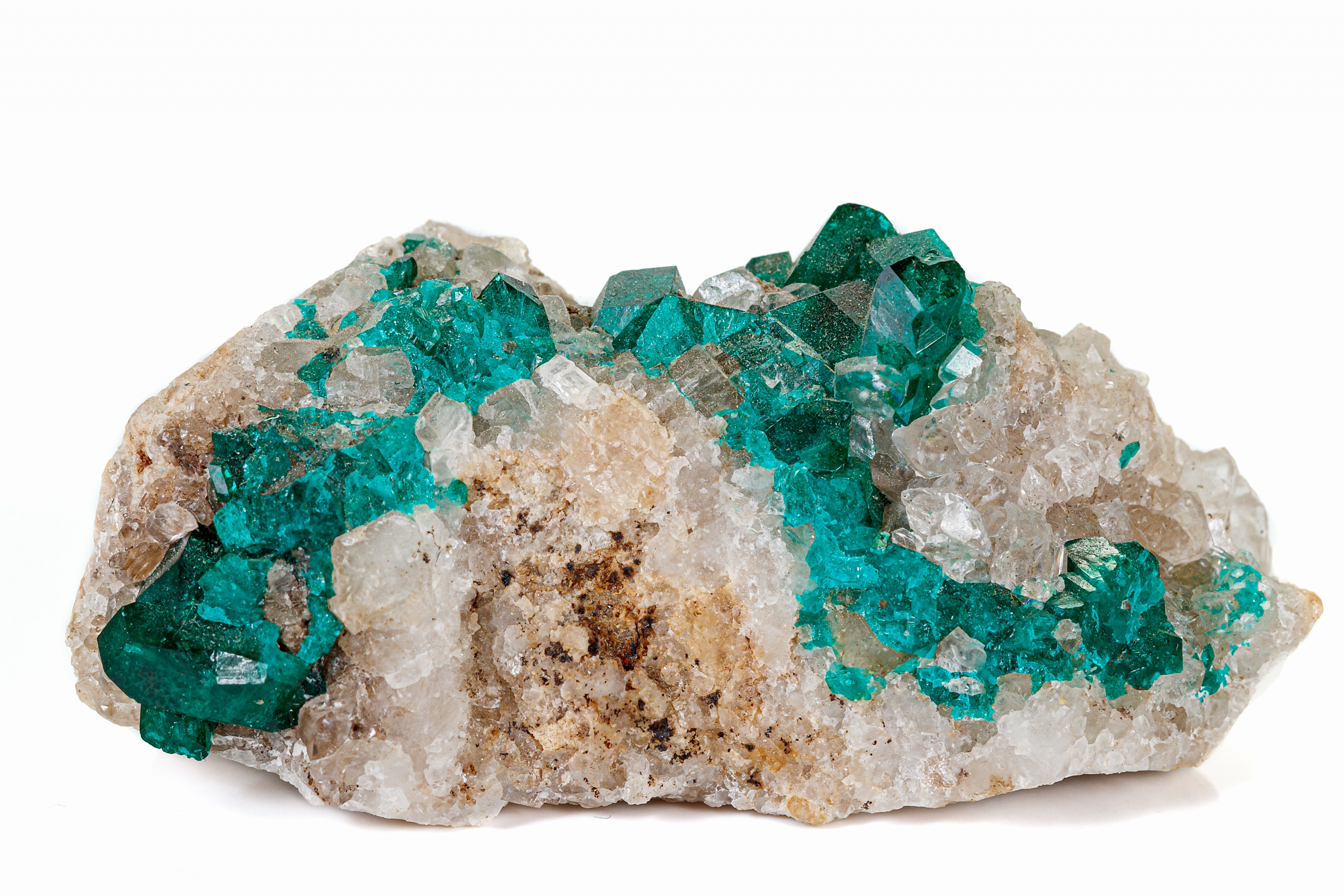

Most specimens on a shelf are a single mineral through and through. Every so often, though, a piece shows two different minerals that crystallized together, sharing space instead of taking turns, and the result reads less like one rock and more like a small record of two separate chemistries meeting at the same time and place.
Needles threaded through mica sheets
This mica specimen is a good example of one version of that: fine, dark tourmaline needles running straight through mica’s characteristic layered sheets. Mica forms in thin, flexible plates because its atomic structure is built from stacked layers that cleave apart easily, almost like pages in a book. Tourmaline crystallizes as long, slender prisms. When both minerals are growing in the same pocket of a pegmatite at roughly the same time, tourmaline needles can push straight through mica’s still-forming layers, getting locked in place as the mica book keeps growing around them. The mica didn’t grow around a finished tourmaline crystal so much as the two grew through each other.
Two crystal habits sharing one matrix
This Herkimer-style quartz cluster shows a related but different arrangement: contrasting cream feldspar crystals grown directly through the quartz-covered matrix rather than threaded inside individual points. Feldspar and quartz are both common igneous and metamorphic minerals, but they crystallize in different shapes and often at slightly different stages as a mineral-rich fluid cools, which is why you get two visually distinct crystal habits sharing one piece of rock instead of one mineral simply coating the other.
What geologists actually call this
The general term is paragenesis, the sequence and relationship of minerals that crystallize together in the same rock. Reading that sequence, which mineral formed first, which grew around or through which, is one of the main ways geologists reconstruct the temperature, pressure, and chemistry a rock experienced without ever seeing it form. It’s also, practically speaking, why these two-mineral pieces tend to be rarer and more collectible than single-mineral specimens: the conditions have to line up for both minerals, not just one.
If you want a mica specimen without an included mineral for comparison, our piece on lepidolite covers a different member of the mica family, one whose real distinguishing feature turned out to be a whole different element locked inside its structure instead of threaded through it.