
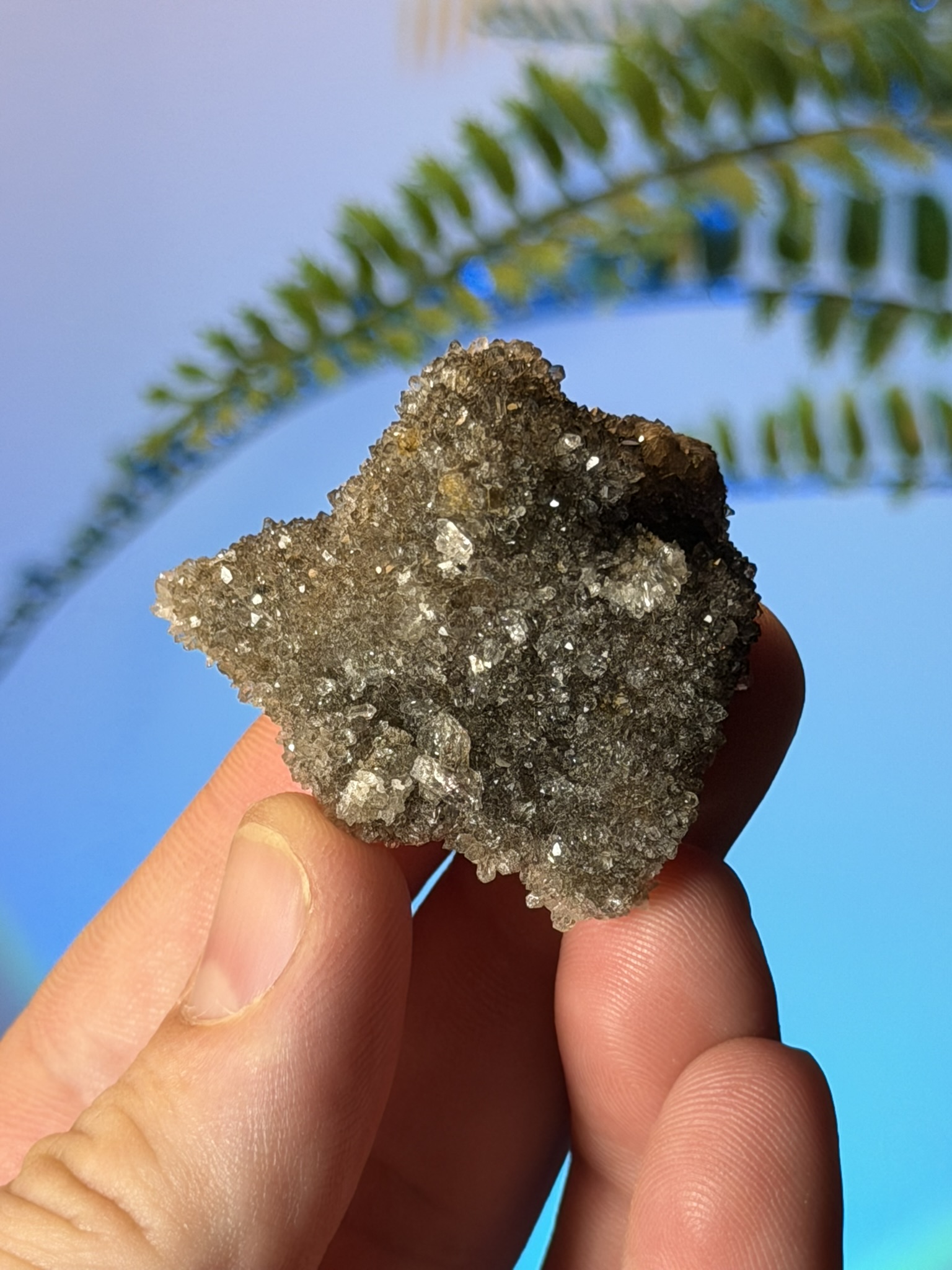
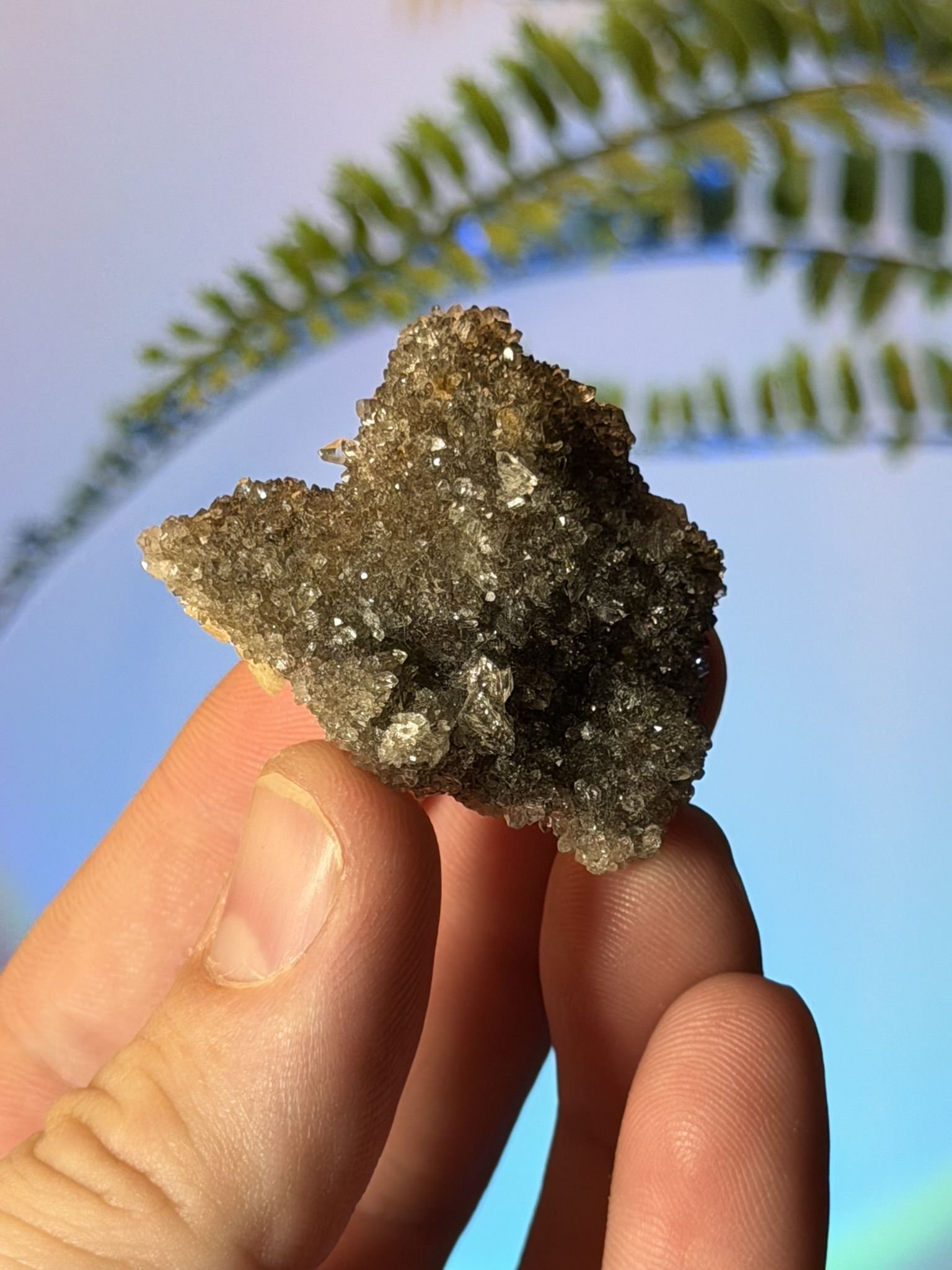
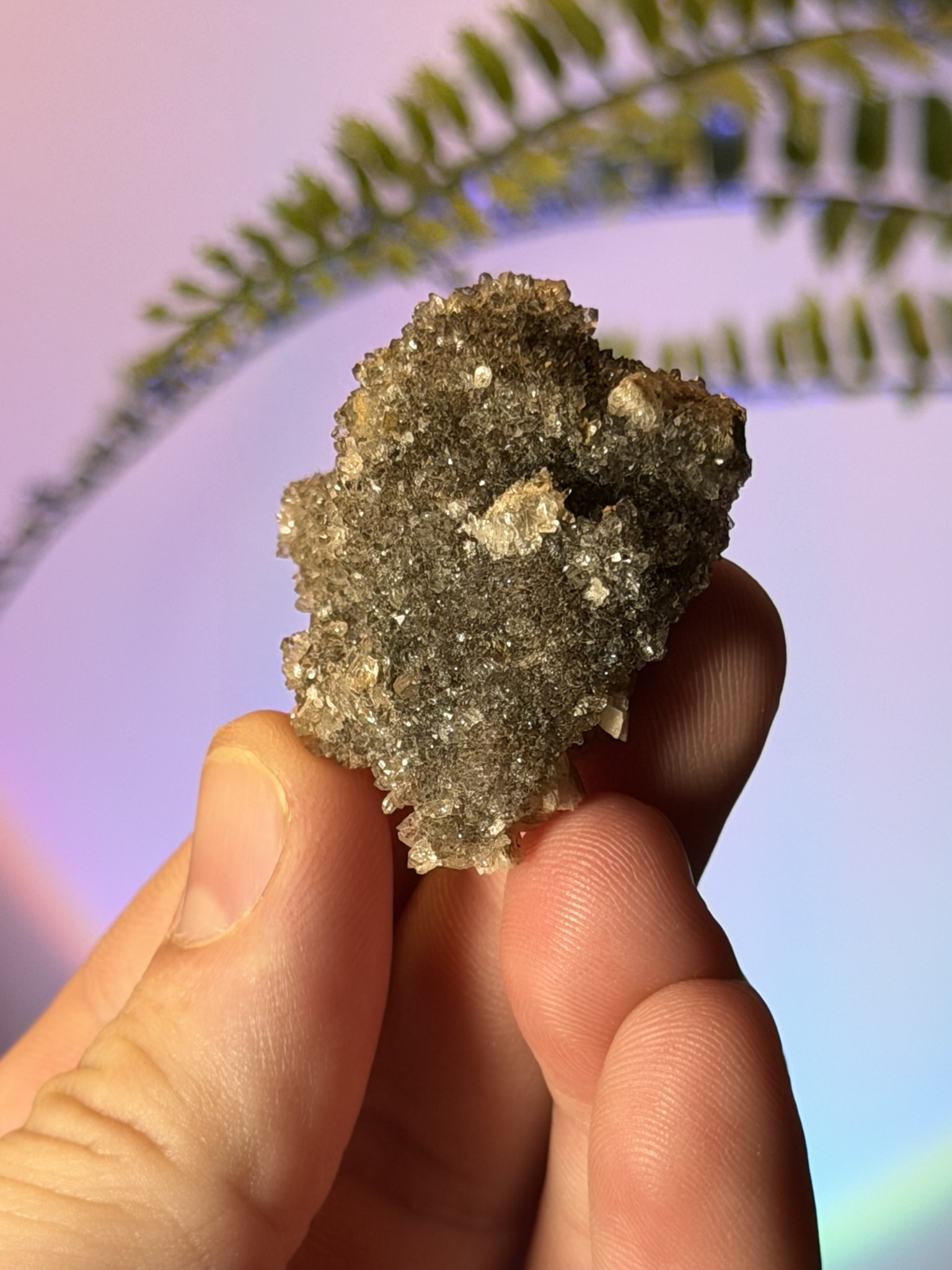
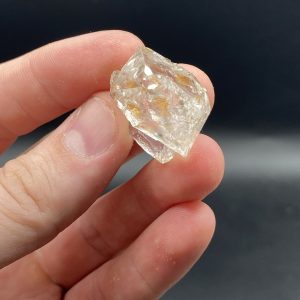
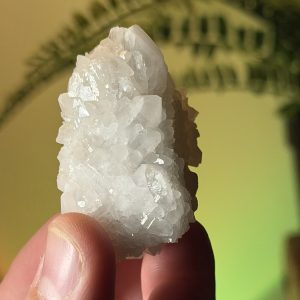
“Herkimer diamonds” are doubly-terminated quartz crystals famously found in vugs within the Cambrian-age Little Falls Dolostone of central New York’s Mohawk Valley — quartz that grew freely in open cavities within the dolostone, with no attachment point, letting it form points on both ends rather than the single termination typical of quartz grown from a base. This specimen is a small druzy cluster in that same style, with numerous sharp, lustrous points across its surface.
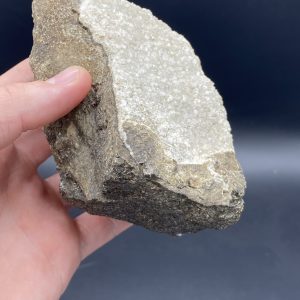
What makes this piece a little different from a typical Herkimer cluster is the cream-colored, blocky feldspar crystals grown directly through the quartz druzy — a mineral pairing that shows both were crystallizing in the same cavity environment. The contrast between the water-clear to smoky quartz points and the opaque, angular feldspar makes for good textural variety on a single piece.
True Herkimer diamonds and Herkimer-style quartz score a 7 on the Mohs scale, making them durable for handling, though individual druzy points can snap off under pressure — handle by the base/matrix rather than gripping the crystal faces. Clean with a soft brush or cloth; ultrasonic cleaners are not recommended given the delicate points.
Inside the Herkimer Diamond
Double-terminated, self-formed, and pulled from one small stretch of upstate New York — here’s what makes every piece in this family genuinely rare.
The story: About 500 million years ago, ancient seas laid down the dolostone of the Little Falls Formation across the Mohawk Valley. As the rock later cracked and shifted, silica-rich groundwater seeped into small open pockets and crystallized slowly — with nothing to attach to. That’s the whole secret: most quartz grows welded to a wall and only shows one finished point. A Herkimer diamond floats free in its pocket and grows a sharp termination on both ends, which is why even a small one already looks “finished” straight out of the ground.
Why collectors chase them: True double termination is uncommon in nature, and the exceptional clarity these crystals can reach — combined with a locality that exists nowhere else on Earth in this form — is what separates a “Herkimer” from ordinary quartz. Some carry smoky color, phantom growth lines, or tiny trapped inclusions, so no two parcels ever look quite the same.
Care: At Mohs 7, quartz shrugs off everyday handling, but those double points are genuinely sharp — store loose pieces so the terminations aren’t grinding against each other, and clean with a soft, dry cloth.
Reviews
There are no reviews yet.