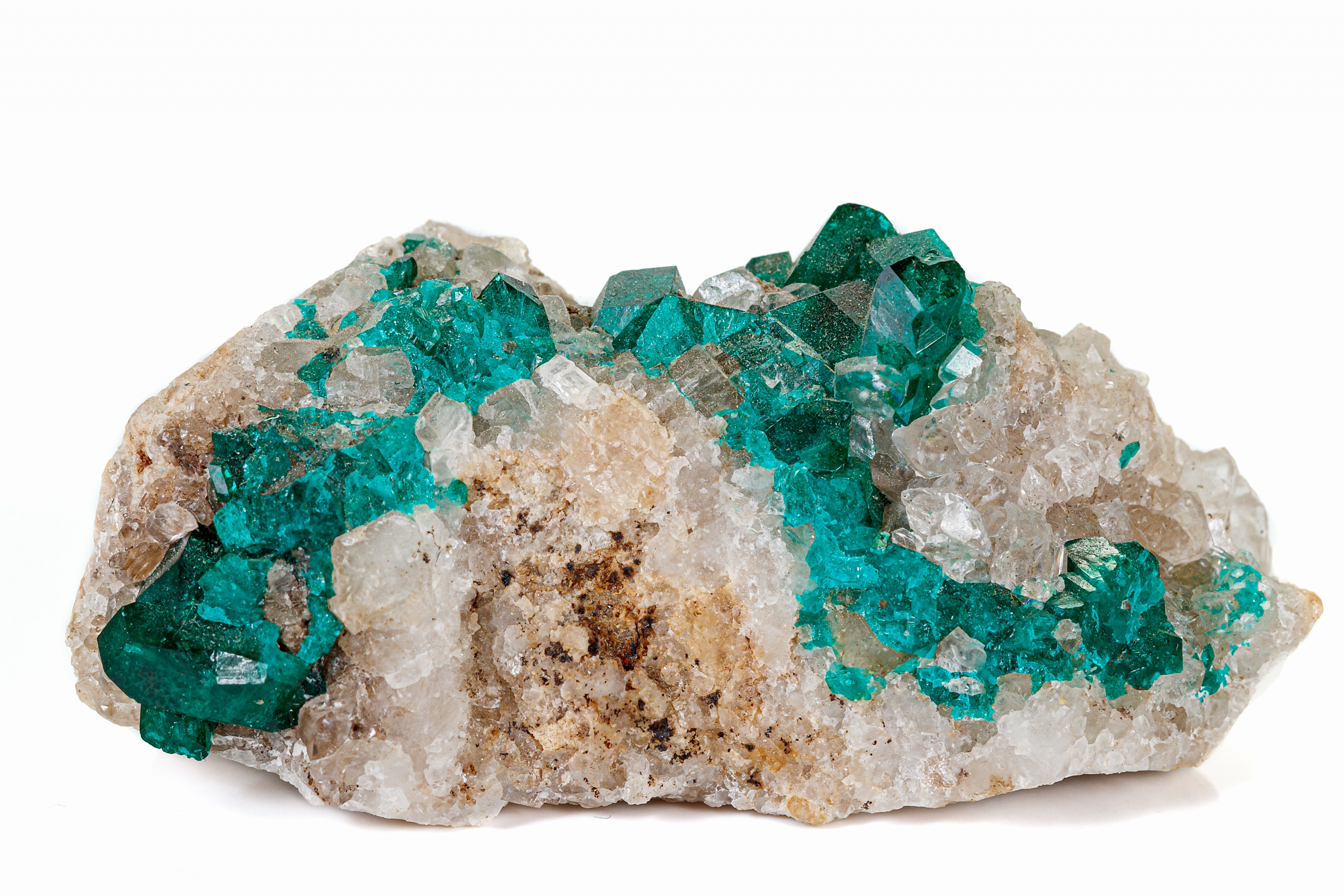

Pure minerals are frequently colorless. Quartz, corundum, beryl, all essentially colorless in their chemically ideal form. Almost everything that makes a mineral collection colorful comes down to trace elements, atoms making up a tiny fraction of a percent of the total structure, doing an outsized amount of visual work. We’ve covered several of these individually; here’s what they actually have in common.
Iron and Aluminum: Quartz’s Two Personalities
Trace iron in quartz, combined with natural background radiation over geologic time, produces amethyst’s purple. Trace aluminum in quartz, exposed to that same kind of radiation, produces smoky quartz’s brown and gray instead. Same host mineral, same basic radiation-driven mechanism, two completely different trace elements, two completely different results. We cover each separately in our pieces on amethyst and smoky quartz.
Manganese: Pink Without Being Related to Pink
Lepidolite’s soft lilac-pink color comes primarily from trace manganese, not from the lithium that actually defines the mineral chemically and gave it its name once lithium was identified in its structure. Lithium itself is essentially colorless. It’s easy to assume the element in a mineral’s name is also the one responsible for its color, and with lepidolite, that assumption is simply wrong. More on that naming history in our lepidolite piece.
Copper: One Element, a Whole Family of Blues and Greens
Copper is one of the most reliable colorants in mineralogy, and it’s responsible for the blue-green family that includes azurite, malachite, chrysocolla, and shattuckite. Different copper minerals produce different exact shades depending on their specific chemistry and structure, which is part of why chrysocolla and shattuckite get mistaken for turquoise, and why azurite slowly turns green as its copper chemistry shifts over time.
The Same Rule, Almost Everywhere
Once you know to look for it, the pattern shows up across nearly the whole shop: a colorless or pale host mineral, a trace element measured in parts per million, sometimes a radiation source thrown in, and the result is the color a specimen actually gets bought for. The element responsible is very rarely the one in the mineral’s own name.