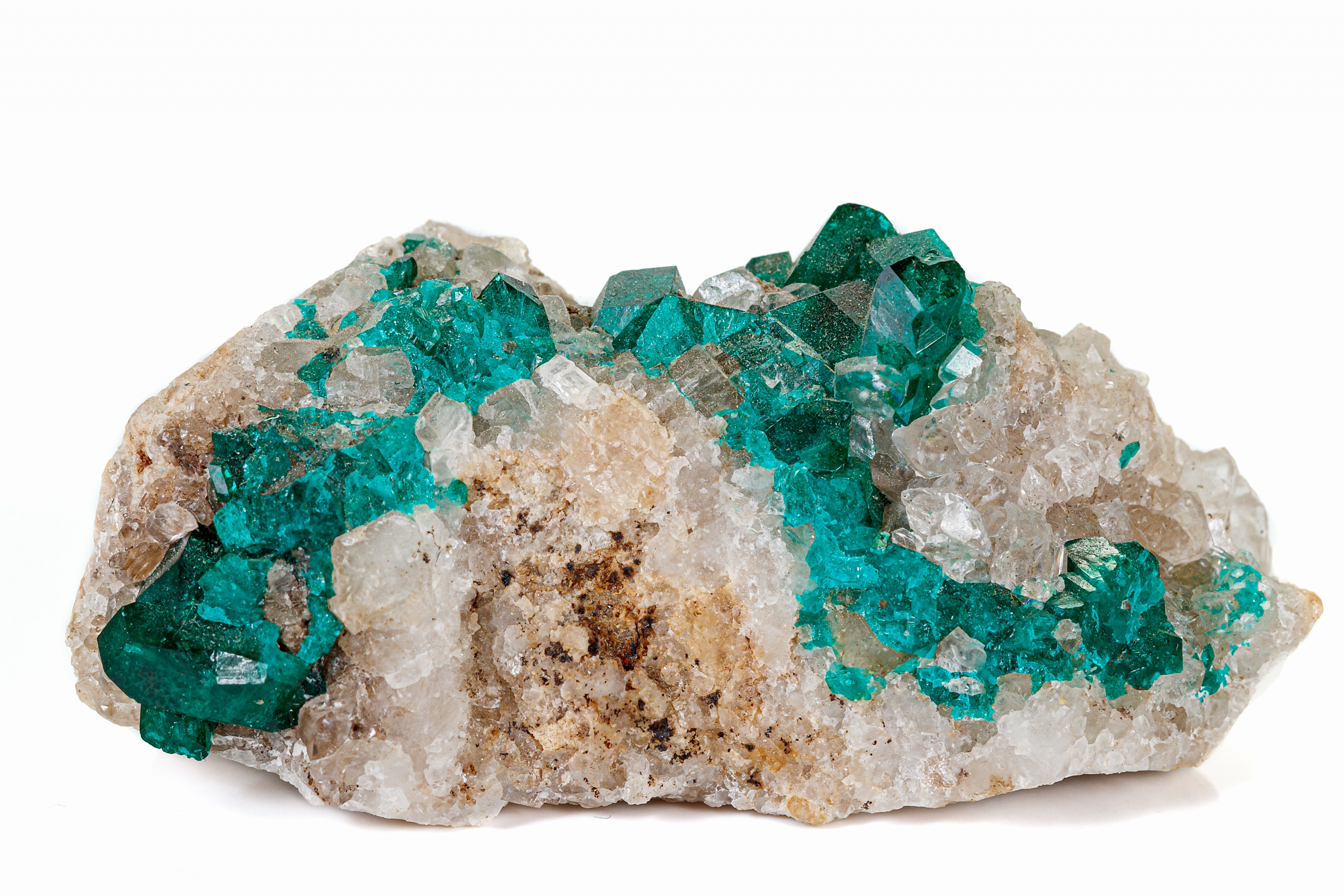

Diamond is not stable at the surface of the Earth. Every diamond you have ever seen is slowly, imperceptibly, trying to become graphite. It does not get there because the conversion requires breaking every carbon bond and rearranging them, which at room temperature effectively never happens. The pair are polymorphs, covered in same element, opposite extremes.
Which raises the question of how something that forms 150 kilometres down ever reaches a mine.
Diamonds do not form in kimberlite
This is the most common misconception. Diamonds crystallise in the lithospheric mantle at depths of roughly 150 to 200 kilometres, at pressures around 5 gigapascals and temperatures near 1,000 to 1,300 degrees Celsius, mostly in old, cold, thick continental roots beneath ancient cratons. Many are over a billion years old, some over three billion, far older than the rock that carries them.
Kimberlite is the delivery vehicle. It picks diamonds up as it passes through and brings them to the surface as passengers, along with other mantle fragments called xenoliths.
The speed problem
Here is the constraint that makes kimberlite eruptions unique. Bring a diamond up slowly, through hot rock, over a long time, and it will convert to graphite. Bring it up while it is still hot and subject it to a slow decompression and you get worthless carbon.
So the ascent has to be fast. Estimates for kimberlite magma ascent run from several metres per second to tens of metres per second, meaning the journey from mantle to surface takes hours, not millennia. The magma is rich in carbon dioxide and water, which exsolve explosively as pressure drops, driving the eruption harder as it rises.
The result is a narrow, steep, carrot-shaped pipe rather than a broad volcanic cone: a diatreme, blasted through the crust, widening toward the top. This is a different animal from the settings in volcanic versus plutonic, because the magma barely interacts with the crust it passes through.
Nobody has ever seen one
No kimberlite eruption has occurred in recorded human history. The youngest known are tens of millions of years old, most are between 70 and 150 million years old, and the great majority erupted before humans existed. It is a style of volcanism the planet appears to have largely finished with, possibly because it requires mantle conditions that have changed as Earth cooled.
Indicator minerals
Diamonds are rare even in diamond-bearing kimberlite, often at grades of well under one part per million. Prospectors therefore do not look for diamonds. They look for indicator minerals that kimberlite carries in far greater abundance: chromium-rich pyrope garnet, chrome diopside, picroilmenite, and specific spinels. These minerals have distinctive compositions that mark mantle origin.
Because they are heavier than ordinary rock debris, they concentrate in stream sediments exactly as described in placer deposits. Exploration geologists sample streams, find indicator grains, and walk upstream. That method found the Canadian diamond fields in the 1990s after years of following garnet trails across the tundra.
The name
Kimberlite is named for Kimberley, South Africa, where the 1871 diamond rush produced the Big Hole, dug largely by hand, and where the modern diamond industry was built. Naming a rock type for its type locality is standard practice, the same convention discussed in how a new mineral becomes a mineral.
What it means for a collector
You will not find diamond in a shop like this one, and that is straightforward economics. What is worth taking from kimberlite is the idea that some minerals are tourists. A specimen can record conditions that no longer exist anywhere near where it was found, which is exactly the reasoning behind how petrified wood ended up on Long Island, just with a far more violent means of transport.