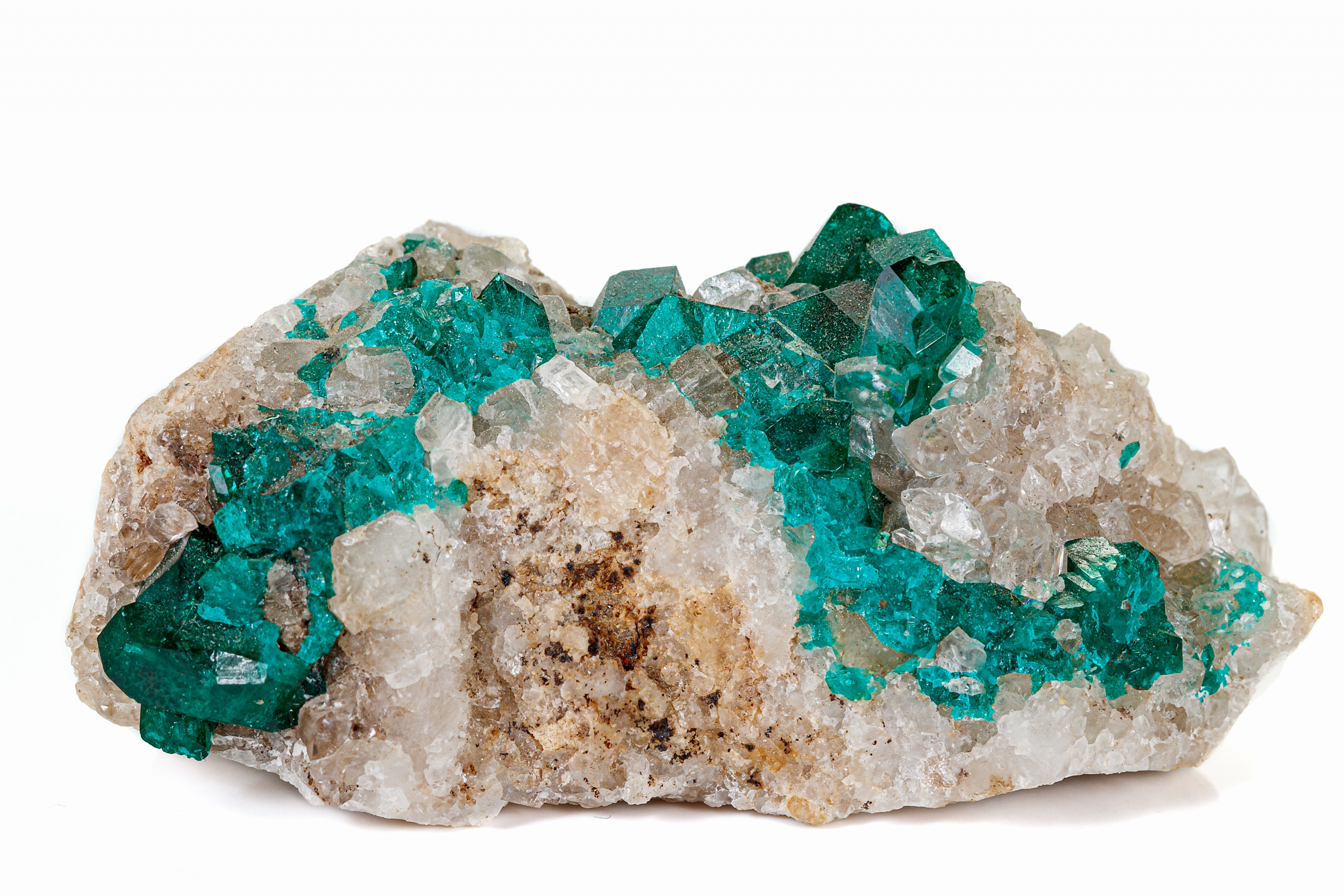

Galena is one of the few common minerals whose crystal habit gives away its internal structure almost without a magnifying glass: it grows as sharp, well-formed cubes, sometimes with the corners slightly trimmed into an octahedral face, a shape direct enough that it’s one of the standard teaching examples for the cubic crystal system.
Lead sulfide, and lead’s main ore
Galena is lead sulfide, PbS, and it has been humanity’s primary source of lead for thousands of years, mined and smelted since antiquity for uses ranging from Roman plumbing to modern batteries. It typically forms in hydrothermal veins alongside sphalerite, another sulfide mineral, and often carries trace silver as an economically important byproduct, which historically made galena deposits worth mining for two metals at once.
Why the cubes form so cleanly
Galena’s cubic habit comes directly from how lead and sulfur ions pack together, alternating in a simple, highly symmetric repeating grid, the same basic atomic logic behind why the cubic system produces such geometrically clean crystals across very different minerals, from galena’s metallic cubes to pyrite’s brassy ones to halite’s salt cubes. That same structure gives galena perfect cubic cleavage, breaking cleanly along three directions at right angles, which is part of why intact, sharp-edged galena crystals are prized separately from the ordinary massive ore ground up for processing.
Galena is also notably dense, one of the heavier common minerals by volume, dense enough that experienced collectors can often identify it by weight alone before checking anything else, a property covered in more depth in our piece on specific gravity.